

I stepped outside in Oakville at 6:30 this morning and I could smell the fire before I saw anything. The sun came up as a dull orange disc. You could look straight at it. SunUp read AQHI 10 — High Risk, with PM2.5 at 129 µg/m³, sourced live from Environment Canada.
That PM2.5 number is the one that should stop you. The World Health Organization's 24-hour guideline is 15 µg/m³. We are sitting at more than eight times that.
Two days ago I wrote about the heat wave and mentioned, almost in passing, that the same stagnant air mass can drag air quality toward the high-risk range. That's exactly what happened. The heat broke and the smoke moved in behind it.
Quick Answer: At AQHI 10, children, adults over 65, pregnant people, and anyone with a heart or lung condition should avoid strenuous outdoor activity — and everyone else should cut back. Wildfire smoke is dangerous because of PM2.5: particles ~28× smaller than a human hair that reach the deep lung and cross into the bloodstream. Protect indoor air by closing windows and running a HEPA or DIY box-fan filter. There is no detox and no supplement that helps.
AQHI 10: what the number is actually asking you to do
Canada's Air Quality Health Index isn't a pollution meter. It's a health-risk score, built from the combined relative risk of ground-level ozone, fine particulate matter, and nitrogen dioxide. It runs 1 to 10+ in four bands, and each band comes with two different sets of instructions — one for people at risk, one for everyone else.
That distinction is the whole point of the index, and it's the part that gets lost when the news just says "air quality is bad today."
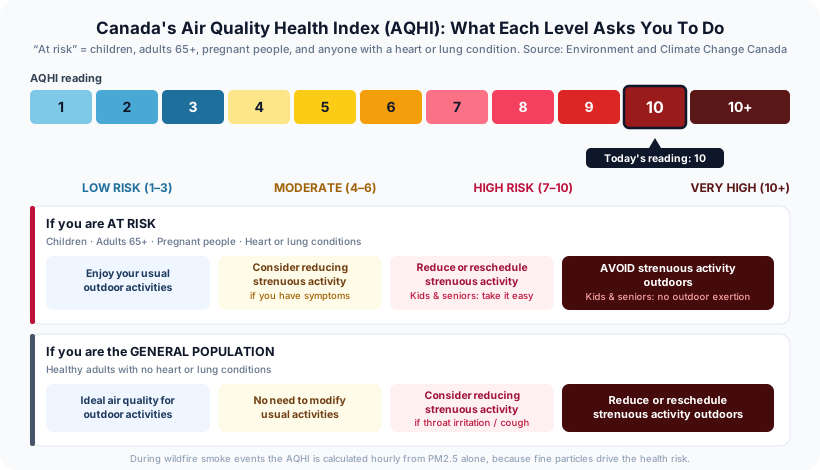
At AQHI 10 the guidance for at-risk groups isn't "be careful" — it's reduce or reschedule strenuous outdoor activity, and kids and seniors should take it easy.
"At risk" is a broader category than most people assume. Health Canada's list covers people with heart or lung conditions, adults 65 and over, infants and young children, pregnant people, outdoor workers, and people with lower socioeconomic status. If you have a seven-year-old and a father in his seventies, two of the people you care about are on that list — and neither of them is likely to check an air quality index on their own.
One thing worth knowing: during wildfire smoke events, Environment and Climate Change Canada switches the AQHI formula so it's calculated hourly from PM2.5 alone. Fine particles are so dominant in smoke that the other pollutants stop mattering to the score.
The two numbers, and why the second one is the real story
SunUp shows the AQHI and the raw PM2.5 concentration together, because they answer different questions. The AQHI tells you what to do. The PM2.5 figure tells you how bad it actually is — and lets you compare today against a fixed international benchmark instead of a relative scale.
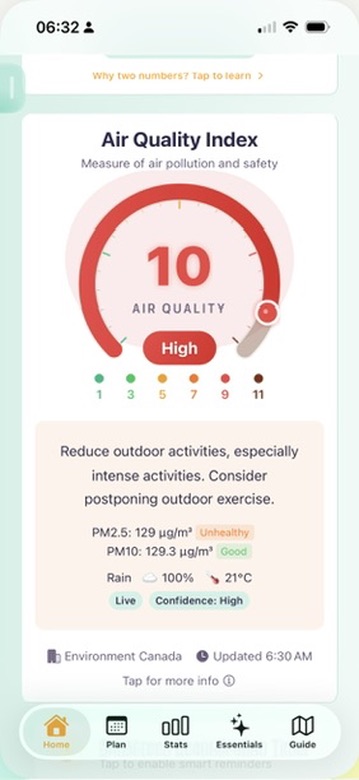
SunUp at 6:32 AM: AQHI 10, PM2.5 129 µg/m³, live from Environment Canada. The gauge is pinned near the top of the scale.
At 129 µg/m³, today's air is roughly 8.6 times the WHO's 24-hour guideline. For a sense of how unusual that is: researchers analyzing the record 2023 Canadian wildfire season defined a "Canada smoke day" as any day where PM2.5 merely exceeded 15 µg/m³ and Canadian fires drove at least half of it. By that definition, 98% of Canadians experienced at least one — an average of 27 days each. Today isn't one of those marginal days. It's eight times the threshold that counts.
Health Canada is blunt about where the floor is: there is no known safe level of exposure for some of these pollutants, and smoke can affect health even at low levels. Risk climbs as levels climb. There's no line below which you're fine.
What PM2.5 does once it's inside you
Here's what I think most people get wrong about smoke: they judge it by what they can see and smell. The haze and the campfire smell are real, but they're not the hazard. The hazard is invisible.
PM2.5 means particles 2.5 micrometres across or smaller. The US EPA puts an average human hair at about 70 micrometres — so a PM2.5 particle is roughly 28 times smaller than a hair. Your nose and throat evolved to catch dust. They do not catch this.
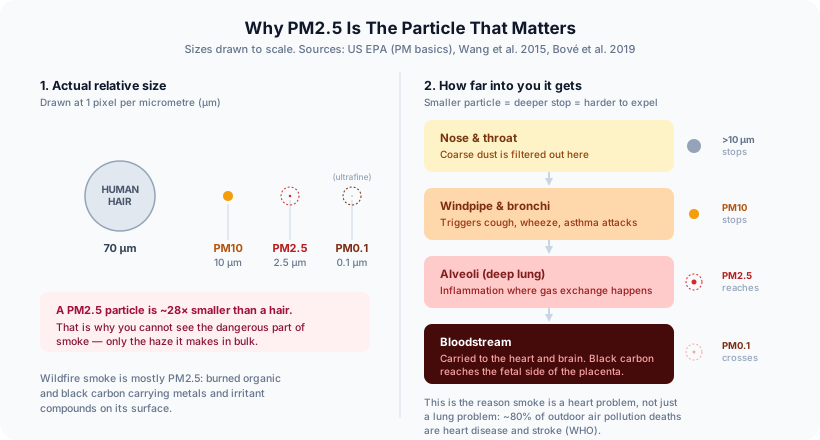
The size determines the destination. Coarse dust stops in your nose and throat. PM10 largely stops in the bronchi. PM2.5 goes all the way to the alveoli — the tiny sacs where your blood picks up oxygen — and deposits there. Some of it doesn't stop even at that point: fine and ultrafine particles can cross the alveolar-capillary barrier and enter the bloodstream.
Once particles are in circulation, this stops being a lung story. The mechanisms researchers describe are systemic: inflammation, oxidative stress, activation of the clotting system, disrupted autonomic control of heart rate and blood vessels, and injury to the endothelial lining of your arteries. That's a recipe for heart attacks and strokes, not just coughing.
The scale of that is easy to underestimate. The WHO attributes about 7 million premature deaths a year to air pollution — one in eight deaths globally. Of the outdoor air pollution deaths, roughly 40% are ischemic heart disease and 40% are stroke. Around 80% of the death toll from outdoor air pollution is cardiovascular. Air pollution kills mostly by damaging hearts.
And the particles travel further than the bloodstream. In a study published in Nature Communications, researchers found black carbon particles on the fetal side of human placentas — combustion particles inhaled by the mother, carried through her blood, and deposited next to fetal circulation. That's why pregnancy is on Health Canada's at-risk list.
Why your kids get a bigger dose than you do
Standing in the same smoke, a child is not getting the same exposure you are. Three things stack against them.
They breathe more often. Clinical reference ranges make this concrete. A one-month-old at rest breathes 40–60 times a minute. You breathe 12–20.
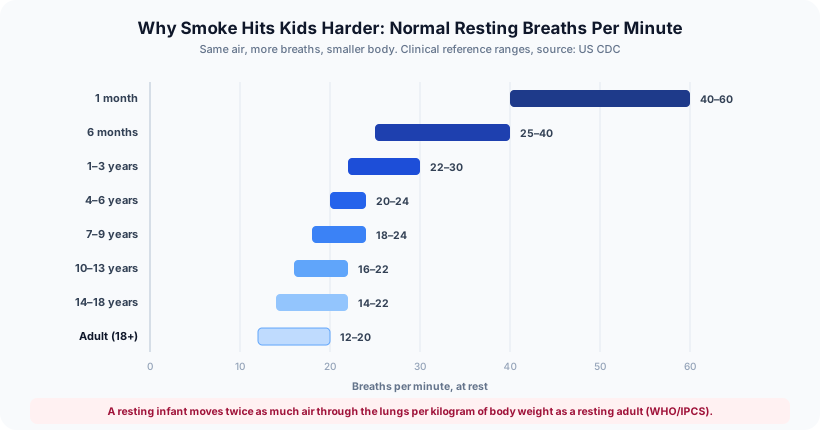
They're smaller. More breaths going into a much smaller body means a bigger dose per kilogram. A WHO/IPCS monograph puts it precisely: the volume of air passing through the lungs of a resting infant is twice that of a resting adult per unit of body weight. The EPA's child-specific guidance says the same thing in plainer language — children have higher inhalation rates per pound of body weight than adults.
You'll see a claim floating around that "children breathe 50% more air per pound than adults, according to the EPA." I went looking for that sentence in EPA's actual documents and couldn't find it — it circulates through blogs citing each other. The well-sourced figure is worse than the popular one: roughly twice the air per kilogram for infants, not 50% more.
Their lungs are still being built. Short-term, smoke means more asthma attacks, more emergency visits, more rescue inhalers. Children's airways are narrower, so the same swelling and mucus chokes off more airflow than it would in you. Long-term, the concern is lung growth itself. A five-year cohort study of school-age children found that higher long-term PM2.5 exposure was associated with measurably lower FVC and FEV₁ — the standard measures of lung capacity and function — after adjusting for age, weight, height, and sex. Lung growth you don't complete in childhood, you don't get back.
Then add behaviour. Kids play outside. They run. Hard exercise multiplies the air they move through their lungs, and it pulls that air deeper — which is the next section, and the one I have to take personally.
Why it's worse for your parents
Older adults are on the at-risk list for a different reason: less reserve.
Age brings stiffer vessels, established atherosclerotic plaque, reduced cardiac reserve, and a higher baseline rate of hypertension and diabetes. So when PM2.5 triggers inflammation, clotting activation, and autonomic disruption, there's less margin before something breaks. Researchers reviewing PM and stroke found the association strongest in older adults and people with existing diabetes.
Two findings from that literature are worth sitting with:
- The link between PM2.5 exposure and ischemic stroke onset is strongest within 12 hours of exposure. This is not a slow, decades-long risk. It's today.
- Moderate PM2.5 exposure (15–40 µg/m³) was associated with a 34% higher ischemic stroke risk than light exposure (≤15 µg/m³). We are at 129 µg/m³.
Health Canada states plainly that less commonly, wildfire smoke exposure can lead to stroke, heart attack, premature death, and reproductive effects including low birth weight. Those words are in official public health guidance because the evidence put them there.
If you have parents in their seventies, today is a phone call. Not a text they'll read tomorrow — a call. They grew up in an era with no air quality index, and "it's just a bit of smoke" is exactly the reasoning that gets someone with a cardiac history out mowing a lawn at AQHI 10.
If you exercise outside, this is your problem more than anyone's
I need to be direct here, because this is the part I'd personally be most tempted to rationalize.
I run. I help lead the Bronte Runners, and I'm a race director. I know exactly what goes through your head when you look out at a hazy morning: it's just haze, I'll take it easy, it's only 40 minutes. I've thought it. It's wrong, and the reason is arithmetic.
Running multiplies your dose. The EPA's Wildfire Smoke Guide puts a number on it: when exercising, people can increase their air intake 10 to 20 times over their resting level. Your lungs don't filter the air — they just accept whatever is in it. So an easy hour outside today, at 129 µg/m³, puts something in the range of ten to twenty hours' worth of resting exposure into your body. That "quick 40 minutes" is not a small dose. It's the biggest dose anyone in your household will take today.
Running defeats your best filter. At any real intensity you stop breathing through your nose and start breathing through your mouth. The EPA is explicit about what that costs: people "breathe through their mouths during exercise, bypassing the natural filtering ability of the nasal passages and delivering more pollution to the lungs." Your nose is a particle filter. Running takes it offline exactly when the air is worst.
Running drives particles deeper. You also breathe harder, not just more, which changes where particles land. In controlled testing, the total number of ultrafine particles deposited in the lungs was more than 4.5 times higher during exercise than at rest — the deposited fraction and the ventilation rate compound each other.
Ten to twenty times the air, through an unfiltered route, pushed deeper into the lung. That's why the American Lung Association's advice to people near wildfire smoke isn't nuanced — it's "don't exercise outdoors". Health Canada's version: reduce or reschedule strenuous outdoor activity, and if smoke lasts more than a few days, find somewhere with cleaner air to train indoors.
So: today is not a run day. Not an easy run, not a short one. Treadmill, gym, bike in the basement, rest day, or a walk you can actually breathe through. Nobody has ever lost fitness in one day. If you're training for something, the session you skip today costs you far less than the flare-up that costs you a week.
And one habit worth building, because it's the reason both numbers live in the same app: check air quality and UV before you go out — not one or the other.
They come apart in a way that fools people. Heavy smoke can cut UV by 20–50%, so today the sun looks weak and feels manageable while the air is genuinely hazardous. The opposite is just as common: a brilliant, clear, AQHI-2 morning where the air is perfect and the UV index is 9 and you'll burn in fifteen minutes. Two independent dials:
- Bad air, weak sun (today) — the risk is what you inhale. Train indoors.
- Clean air, strong sun — the risk is what lands on your skin. Go, but wear the hat and the sunscreen and watch the clock.
- Bad air, strong sun — late summer's specialty. Both apply. Indoors.
The mistake is checking one dial and assuming it speaks for the other. It doesn't.
How to check it — for yourself and for the people you're responsible for
The practical problem isn't information. Environment Canada publishes the AQHI for free. The problem is that nobody checks a government webpage before deciding whether their kid's practice should go ahead.
Here's what I'd actually do:
- Check the number before you commit to the day, not after. The decision that matters — practice, long run, yard work, or none of it — gets made in the morning.
- Check it for your location, not your city. Smoke is patchy. A regional headline doesn't tell you about your street.
- Look at both numbers. The AQHI tells you what to do. PM2.5 in µg/m³ tells you how far past the WHO's 15 µg/m³ guideline you are.
- Decide per person, not per household. Same air, different instructions. At AQHI 10, a healthy 40-year-old is told to reduce strenuous activity. Your asthmatic eight-year-old is told to avoid exertion outdoors. It's the same logic as planning sun protection per family member rather than for the group.
- Believe the number over your nose. You acclimate to the smell of smoke within an hour or two. The particles don't care that you stopped noticing them.
SunUp pulls AQHI and PM2.5 for your GPS location from Environment Canada, alongside the UV index — which matters more than it sounds, because smoke and UV interact in ways that fool people. Heavy smoke can cut UV by 20–50%, so a smoky day feels safer for skin while being considerably more dangerous for your lungs and heart. I wrote about that interaction in detail here. If you want the full tour of what the app tracks, that's in the complete feature guide.
Protecting the air inside
This is the part I'd argue matters most, because it's where you'll spend today.
You should absolutely protect kids from the sun outside — hats, shade, the whole system. But sun protection is about the two hours you're at the park. Air is about the twenty-two hours you're not. On a smoke day, indoor air is most of your exposure, and it is the only air you actually control.
Being indoors helps by default — outdoor air is the main source of indoor PM2.5 during a smoke event, and a building knocks some of it down. But particles come in through open windows, envelope leaks, and fresh-air intakes. Indoors is a starting position, not a solution. It becomes protection when you defend it.
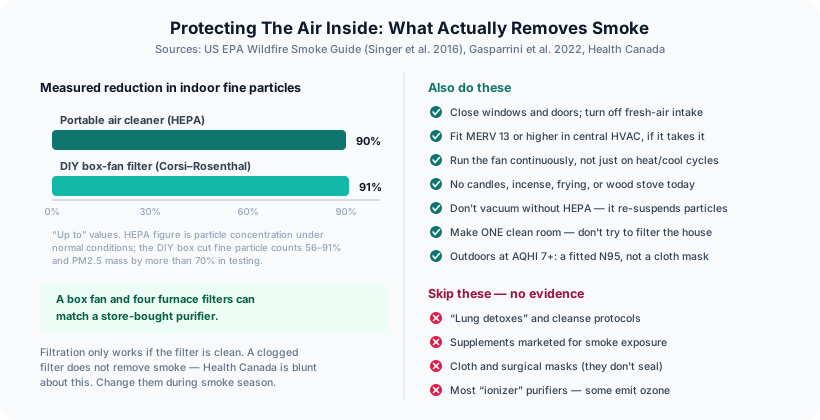
The measured numbers here are genuinely encouraging. The EPA's Wildfire Smoke Guide reports that portable air cleaners with high-efficiency filters can cut indoor particle concentrations by as much as 90%. And a DIY Corsi-Rosenthal box — a box fan with four furnace filters taped into a cube — cut fine particle counts by 56–91% and PM2.5 mass by more than 70% in testing. A hardware-store build performs in the same league as a retail purifier. That's a rare thing in health advice: the cheap option actually works.
The rest of the playbook:
| Do this | Why |
|---|---|
| Close windows and doors; turn off fresh-air intake | Stops the main infiltration route |
| MERV 13 or higher in central HVAC, fan running continuously | Filters the air you already have, repeatedly |
| Pick ONE clean room and defend it | Filtering a whole house is a losing fight; a bedroom isn't |
| No candles, incense, frying, or wood stove | Indoor sources stack on top of the smoke |
| Don't vacuum without a HEPA vacuum | Vacuuming re-suspends settled particles |
| Change filters — a clogged filter doesn't work | Health Canada is explicit about this |
| Can't get clean air at home? Go somewhere that has it | Libraries, community centres, malls, gyms |
If you only do one thing today: pick the room where your kids sleep, close it up, and put a filter in it.
What doesn't work
Two of the most common things people search during smoke events are how to detox from wildfire smoke and which supplements to take for it. I'd rather be straight with you than sell you something.
There is no detox. No cleanse, juice, tea, or breathing protocol has been shown to remove fine particles from your lungs. Your body clears what it can; some particles are never cleared, and some have already left your lungs for your bloodstream. No supplement has been shown to protect you from smoke, and no major health agency recommends one. If a product is being marketed to you this week specifically because of smoke, that's a marketing decision, not a clinical one.
Skip the cloth mask too. It doesn't seal and it doesn't filter PM2.5. If you must be outside for a stretch at AQHI 7+, wear a properly fitted N95 or KN95. And be careful with "ionizer" air purifiers — some generate ozone, which is itself a respiratory irritant. You want filtration, not chemistry.
The only intervention with real evidence behind it is unglamorous: reduce your dose. Less time in it, less exertion while in it, cleaner air where you sleep.
This isn't a one-off anymore
It's tempting to treat today as freak weather. The data says otherwise.
The 2023 Canadian wildfire season was the largest in modern records, and its reach was continental. Researchers estimate that 354 million people across North America and Europe were exposed to at least one Canadian smoke day, totalling 4.84 billion person-days. In the US alone, 267 million people — about 79% of the population — were exposed. Chronic exposure from that single season is estimated to have caused 82,100 premature deaths worldwide.
That's one fire season, from one country, and the people dying were mostly nowhere near a fire. Wildfire smoke has stopped being a regional inconvenience and become a recurring, continental public health event. Which is a long way of saying: the AQHI is turning into a number you check in summer the way you check the UV index. That's why it's in SunUp.
What I'm doing today
No run. It wasn't quite as easy a call as it should have been — it's a Thursday, I had a session planned, and the haze looks survivable. But an hour out there at 129 µg/m³ means ten to twenty times the air intake, through my mouth, driven deep. There is no session worth that. It moves inside.
Windows stayed shut. Furnace fan is running continuously with a fresh filter. One room is the clean room. If I have to be out for more than a few minutes, it's an N95, not the buff around my neck.
And I called my parents, because they weren't going to check.
Checking a number takes five seconds. On a day like today it's the difference between a normal Thursday and an asthma attack, and — for someone with the wrong cardiac history — potentially a great deal more than that.
FAQ
What are common symptoms of wildfire smoke exposure?
Health Canada lists headaches, mild cough, increased mucus, and irritation of the eyes, nose, throat, and sinuses as common and usually manageable at home. More serious signs — wheezing, chest pain, severe cough, dizziness, shortness of breath, heart palpitations, or an asthma attack — warrant medical attention or urgent care. Symptoms can appear at low smoke levels and get worse as levels rise.
How do I detox from wildfire smoke?
You don't, and no credible health agency recommends a detox. There is no evidence that cleanses, juices, or breathing protocols clear fine particles from your lungs. Your body clears what it can on its own, and some particles are never removed. The only intervention supported by evidence is reducing further exposure: get into filtered indoor air, cut physical exertion, and wait for the smoke to pass.
What supplements are good for wildfire smoke exposure?
None have been shown to protect you from wildfire smoke, and no major public health agency — Health Canada, the US EPA, or the WHO — recommends any supplement for smoke exposure. Products marketed for smoke or lung detox are not backed by evidence. Spend the money on a HEPA air cleaner or furnace filters instead, where the effect on your actual PM2.5 dose is measurable.
How long does it take to recover from wildfire smoke exposure?
Mild irritation — scratchy throat, sore eyes, a cough — usually clears within hours to a few days once you're out of the smoke. People with asthma or COPD can take longer, and a smoke-triggered flare may need medication or medical care. Cardiovascular risk is more immediate than most people expect: the association between PM2.5 exposure and ischemic stroke onset is strongest within 12 hours of exposure.
Is it safe to exercise outside during wildfire smoke?
At AQHI 7–10 (High Risk), children, adults over 65, pregnant people, and anyone with a heart or lung condition should reduce or reschedule strenuous outdoor activity, and everyone else should cut back if they feel throat irritation or a cough. At 10+ (Very High Risk), at-risk groups should avoid outdoor exertion entirely. Exercise makes it worse because harder breathing pulls a bigger dose of particles deeper into your lungs.
Can I go for a run in wildfire smoke?
You shouldn't. The US EPA notes that exercising increases your air intake 10 to 20 times over resting level, and that people breathe through their mouths when exercising, bypassing the nose's natural filtering. Deposited ultrafine particles measure over 4.5 times higher during exercise than at rest. The American Lung Association's guidance for people near wildfire smoke is simply "don't exercise outdoors." Move the session indoors or take the day off.
Should I check UV or air quality before exercising outside?
Both — they're independent and they come apart. Heavy smoke can cut UV by 20–50%, so a smoky day feels safer for your skin while being hazardous to breathe. A clear day can have perfect air and a UV index of 9 that burns fair skin in about 15 minutes. Checking one number tells you nothing about the other, which is why SunUp shows AQHI, PM2.5, and UV together for your location.
Does staying indoors protect you from wildfire smoke?
Partly. Outdoor air is the main source of indoor PM2.5 during a smoke event, and particles get in through open windows, gaps in the building envelope, and fresh-air intakes. Indoor levels are usually lower than outdoors but can still be high. Indoors only becomes real protection when you actively defend it: windows closed, a MERV 13 or better filter, and a HEPA or DIY box-fan air cleaner running.
Do cloth or surgical masks help against wildfire smoke?
No. Cloth and surgical masks don't seal to your face and don't filter particles in the PM2.5 range, so they offer minimal protection against smoke. A properly fitted N95 or KN95 is the option that works outdoors during heavy smoke. Facial hair, a loose fit, or a gap at the nose will defeat even a good respirator.
Why does SunUp show both an AQHI number and a PM2.5 number?
They answer different questions. The AQHI (1 to 10+) is a health-risk score that tells you what to do today. PM2.5 in µg/m³ is the raw concentration of fine particles, which tells you how bad the air actually is and lets you compare it to the WHO guideline of 15 µg/m³ over 24 hours. During wildfire smoke events, Environment and Climate Change Canada calculates the AQHI hourly from PM2.5 alone.
Sources
- Health Canada — Wildfire smoke and your health
- Environment and Climate Change Canada — About the Air Quality Health Index
- WHO — Global Air Quality Guidelines (2021)
- WHO — 7 million premature deaths annually linked to air pollution
- US EPA — Particulate Matter (PM) Basics
- US EPA — Wildfire Smoke: A Guide for Public Health Officials
- Zhang et al., Nature (2025) — Long-range PM2.5 pollution and health impacts of the 2023 Canadian wildfires
- Bové et al., Nature Communications (2019) — Black carbon particles on the fetal side of the human placenta
- Wang et al. (2015) — PM2.5 and cardiovascular disease in the elderly
- Lamorie-Foote et al. (2023) — Particulate matter and ischemic stroke: a systematic review
- Li et al. (2020) — Long-term PM2.5 exposure and lung function in children
- Gasparrini et al. (2022) — Corsi-Rosenthal box performance
- American Lung Association — Wildfires and lung health
- Daigle et al. (2003) — Ultrafine particle deposition in humans during rest and exercise
- WHO/IPCS — Environmental Health Criteria 59: Principles for evaluating health risks from chemicals during infancy and early childhood
This article is general information, not medical advice. If you have a heart or lung condition, follow your doctor's guidance on activity and medication during smoke events. Severe symptoms — chest pain, confusion, serious shortness of breath — are an emergency. Call 911.
Apply This Knowledge With SunUp
Get real-time UV data personalized for your skin type, location, and activity.
Download Free — iOS