


The UV index sits quietly in your weather app between temperature and wind speed — and most people have no idea what it actually means. A number like "7" tells you almost nothing without context. Seven what? Is that bad? Do I need sunscreen? How long can I stay outside?
This article answers all of that. By the end, you'll know exactly what every UV index number means, how the scale was created, what drives UV up or down, and how a tool like SunUp uses UV data to give you a genuinely useful recommendation — not just a number.
Quick Answer: The UV index is a standardized scale (0 to 11+) measuring solar UV radiation intensity, developed by the WHO and WMO. UV 3–5 means sun protection is recommended; UV 6–7 means everyone needs sunscreen; UV 8+ means protection is essential and midday exposure should be limited; UV 11+ means fair skin can burn in under 15 minutes.
What Is the UV Index?
The UV index is a standardized measurement of the intensity of ultraviolet radiation from the sun at a specific location and time. It was developed by the World Health Organization (WHO) and World Meteorological Organization (WMO) in the 1990s to give people a universal, easy-to-compare measure of UV exposure risk.
Before the UV index existed, forecasters would describe UV risk differently in every country — sometimes in scientific units, sometimes vaguely. The UV index solved this by creating a single integer scale that's identical whether you're in Toronto, Miami, or Sydney.
The scale runs from 0 (no UV) to 11+ (extreme UV). The plus sign matters: there's no upper cap. In equatorial regions at altitude, UV index values of 15, 17, or even 20 have been recorded.
The Full UV Index Scale (WHO Standard)
| UV Index | Risk Level | What It Means |
|---|---|---|
| 0–2 | Low | Minimal UV risk. Sun protection not required for most people. |
| 3–5 | Moderate | Some risk of harm. Sun protection recommended for sensitive skin. |
| 6–7 | High | High risk of harm. Sun protection needed for everyone. |
| 8–10 | Very High | Very high risk. Sun protection essential. Limit midday exposure. |
| 11+ | Extreme | Unprotected skin can burn in minutes. Take full precautions. |
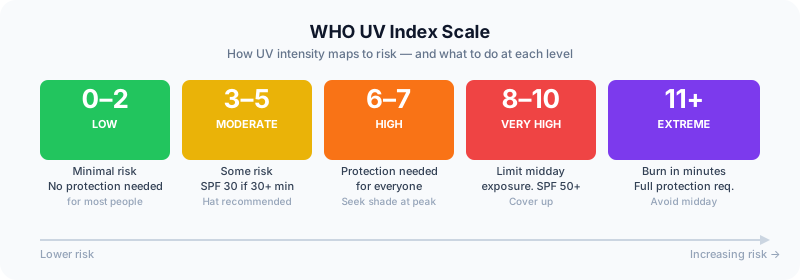
This scale was designed so that each step of 3 roughly doubles your effective UV dose. Going from a UV index of 3 to 6 isn't 2x harder on your skin — it's 4x, because UV damage accumulates exponentially at higher intensities.
What Drives the UV Index Up or Down?
The UV index at any location and time is influenced by several factors:
1. Solar Elevation (Time of Day)
UV intensity peaks when the sun is directly overhead. In most of the continental United States, UV peaks between 10 AM and 2 PM, with the highest values between 11 AM and 1 PM. UV in the morning (8–9 AM) or late afternoon (4–5 PM) may be 60–80% lower than the midday peak.
2. Season
Summer brings significantly higher UV than winter, even at the same latitude. The Earth's tilt changes how much atmosphere UV has to travel through. At 45° North latitude (Toronto, Portland), the midsummer UV index can reach 9–10, while midwinter rarely exceeds 2–3.
3. Latitude
The closer to the equator, the higher the UV. Miami sits at 26° North — its UV index regularly hits 11–12 in summer. Fairbanks, Alaska (64° N) might peak at 5–6. This is why skin cancer rates correlate so strongly with latitude in countries like Australia.
4. Altitude
UV increases approximately 10–12% for every 1,000 metres of elevation gain. This is why skiers get sunburned so easily — at 3,000 metres, UV intensity can be 30–40% higher than at sea level. At Machu Picchu (elevation 2,430m) in Peru, UV routinely hits 15–20.
5. Cloud Cover
This one surprises people. Thick cloud cover can reduce UV by 70–80%. But thin or broken cloud cover may barely reduce UV at all — and in some cases, reflection off clouds can temporarily increase UV above what you'd see in clear sky. This is why people get burned on overcast beach days.
6. Ozone Layer
The stratospheric ozone layer absorbs UV-B radiation, the type most responsible for sunburn and skin cancer. Thinning of the ozone layer (particularly over Antarctica and southern South America) is why UV index values in those regions regularly reach extreme levels.
7. Surface Reflection (Albedo)
UV reflects off surfaces. Snow reflects up to 80% of UV back at you — meaning you're getting UV from above and below. White sand reflects 15–25%. Grass reflects roughly 2–3%. Water reflects 10% normally, but more at low sun angles.
UV Index Versus UV Dose: A Critical Distinction
The UV index measures intensity at a moment in time. But what damages your skin is total dose — intensity multiplied by time.
A UV index of 6 for 30 minutes and a UV index of 3 for 60 minutes deliver the same UV dose to your skin.
This is why a UV index number alone is incomplete information. You also need:
- How long you'll be outside
- Your skin's sensitivity (Fitzpatrick skin type)
- What activity you're doing (swimming removes sunscreen)
- Whether you're using sunscreen, and what SPF
SunUp combines all of these factors to give you a personalized safe time — not just "UV index is 7." For the full breakdown of how long you can safely be outside by skin type and UV level, see our sun exposure time guide.
How SunUp Uses the UV Index
SunUp pulls real-time UV index data for your exact GPS location, updated every 15 minutes. But the UV index is just the starting point.
The app combines:
- Real-time UV index from OpenWeatherMap (your location, current conditions)
- Your Fitzpatrick skin type (I through VI — see our skin type guide)
- Your activity (different activities have different exposure multipliers — swimming, cycling, skiing all affect how much UV you receive)
- Duration (how long you're planning to be outside)
- Air quality (haze and particulate matter can affect UV penetration)
The result isn't "UV is 7, protect yourself." It's "you can be outside safely for approximately 35 minutes before applying SPF 30. If you're swimming, reduce that to 20 minutes."
That's the difference between a weather app and a sun safety app.
When Should You Actually Worry?
Here's a simple mental model:
UV 0–2: Enjoy the outdoors. If you're very fair or have a history of skin cancer, consider light protection.
UV 3–5: Apply sunscreen if you're spending more than 30–45 minutes outside, especially between 10 AM–2 PM. A wide-brim hat is a good idea.
UV 6–7: This is the most common summertime range in Canada and the northern US. SPF 30+ is important. Seek shade during peak hours. A UPF 50+ hat is worth it.
UV 8–10: Common in the southern US, Caribbean, and anywhere south of 35° N latitude in summer. Sunscreen every 2 hours. Protective clothing matters. Limit midday time outside.
UV 11+: Extreme. You can get a meaningful sunburn in under 15 minutes if you're fair-skinned. This is normal in Florida, Hawaii, and equatorial regions year-round. Full protection required.
Common UV Index Myths
"I can't get burned on a cloudy day." False. Thin cloud cover provides minimal UV protection. UV-B passes through cloud more readily than visible light, which is why a cloudy beach day feels cooler but delivers nearly the same UV dose.
"The UV index doesn't matter in winter." It's lower, but not zero. UV index of 3–4 is enough to cause gradual skin damage with repeated exposure. Skiers at elevation face UV 6–8 even in January.
"SPF 100 is twice as good as SPF 50." SPF 50 blocks 98% of UV-B. SPF 100 blocks 99%. The practical difference is minimal — reapplication frequency and coverage matter far more than SPF number differences above 30.
"I have dark skin so UV doesn't affect me." Higher melanin content provides meaningful natural protection (equivalent to roughly SPF 13 for Type VI skin). But it doesn't eliminate UV damage — darker skin still accumulates DNA damage, ages, and can develop skin cancer, just more slowly than fair skin.
The Bottom Line
The UV index is a useful tool — but only if you understand what it means for you specifically. The same UV index of 8 poses very different risks to a fair-skinned redhead and a dark-skinned individual who's spent decades outdoors.
SunUp's job is to translate the UV index from an abstract number into a personalized recommendation: exactly how long you can safely be outside, doing your specific activity, with your specific skin.
Download SunUp free and stop guessing.
FAQ
What UV index is dangerous?
UV index 6–7 is classified as High by the WHO — meaning sun protection is required for everyone, not just sensitive skin. UV 8–10 (Very High) is where serious damage risk begins with short unprotected exposures. UV 11+ (Extreme) is where fair skin can burn in under 15 minutes. In practical terms, anything above UV 5 warrants real sun protection, and above UV 8 you should actively limit midday exposure without full protection.
What UV index causes sunburn?
Any UV level can cause a sunburn given enough time and the right skin type — but in practice, UV 6 and above is where burning risk becomes significant for most people within an hour or two of unprotected exposure. At UV 10+, very fair skin can burn in 10–15 minutes without protection. The actual time depends on your Fitzpatrick skin type — see our skin type guide for the full breakdown.
What UV index is safe without sunscreen?
For most adults, UV 1–2 poses minimal risk for typical outdoor durations. UV 3 is where dermatologists generally recommend sun protection measures begin — particularly for fair skin, children, and anyone spending more than 30 minutes outside. By UV 6, sunscreen is recommended for everyone. There's no universally "safe" UV level — it always depends on duration, skin type, and other factors like altitude and reflective surfaces.
Is the UV index the same everywhere?
No. UV index is location-specific — it varies by latitude, altitude, local cloud cover, and atmospheric conditions. A UV index forecast for a city is an estimate, but conditions can differ significantly within a few kilometers. Apps that use your GPS location give a more accurate reading than a city-level forecast, especially if you're at a different elevation than the city center.
How accurate is the UV index forecast?
UV index forecasts are generally reliable 24–48 hours out for the expected peak UV, but cloud cover variation can make real-time UV differ meaningfully from the morning forecast. For the most accurate reading, apps that pull current UV data (not just forecast) from your location — like SunUp, which updates every 15 minutes — are more useful for in-the-moment decisions than a static daily forecast.
Apply This Knowledge With SunUp
Get real-time UV data personalized for your skin type, location, and activity.
Download Free — iOS