


Protecting your family from UV damage is one of the highest-leverage health decisions you'll make as a parent. The reason is grim but important: more than 80% of lifetime UV exposure occurs before age 18, and studies consistently show that blistering sunburns in childhood and adolescence significantly increase lifetime skin cancer risk — particularly melanoma.
But "be more careful about sunscreen" isn't actionable advice. This guide gives you the specific, science-backed information you need to protect every member of your family — from the infant in the stroller to the teenager who thinks they're invincible.
Quick Answer: More than 80% of lifetime UV exposure occurs before age 18. Children's skin is thinner, more UV-sensitive, and has more active melanocytes than adult skin. Babies under 6 months should be kept out of direct sun entirely. From 6 months onward, SPF 30+ applied 15–30 minutes before sun exposure and reapplied every 2 hours is the minimum standard.
Why Children's Skin Is Different
Children's skin is not just smaller adult skin. It's genuinely different in its UV sensitivity:
Thinner dermis: Children's skin, especially in the first few years of life, has a thinner dermis (middle skin layer). UV penetrates more deeply relative to the skin thickness.
More active melanocytes: The cells that produce melanin are highly active in childhood skin, which means damage from UV can have more pronounced long-term effects on pigmentation.
Higher surface area to body weight ratio: Infants and toddlers have proportionally more exposed skin relative to their body mass. A child lying in a stroller has essentially their entire body facing the sky.
Less effective repair mechanisms: Adult skin has had decades of UV exposure and has adapted (to varying degrees) with more robust DNA repair enzyme activity. Children's repair systems are less mature.
Long accumulation period: A child born today has 70-80 years of UV accumulation ahead of them. Preventing damage now compounds in their favor over their entire life.
Age-Specific UV Protection: What You Need to Know
Under 6 Months: Sun Avoidance
The American Academy of Pediatrics is clear on this: keep infants under 6 months out of direct sunlight entirely. Their skin is too sensitive for sunscreen, and their thermoregulation isn't mature enough to handle heat stress.
What to do instead:
- Use a stroller with a hood/canopy rated UPF 50+
- Dress in long-sleeve onesies and wide-brim hats
- Schedule outdoor time before 10 AM or after 4 PM
- Use physical shade (trees, covered areas) when outdoors
If sun exposure can't be avoided, a minimal application of mineral sunscreen (zinc oxide, titanium dioxide) to exposed areas is acceptable after 6 months. Check with your pediatrician.
6 Months to 3 Years: Beginning Sun Safety Habits
Start applying SPF 30 broad-spectrum sunscreen 20 minutes before outdoor time. Use mineral (physical) sunscreens — they're less likely to cause skin irritation than chemical formulas.
Key practices:
- Wide-brim hat with chin strap (so it stays on when they run)
- Long sleeves for extended outdoor play
- Reapply every 90 minutes and after water play
- Model sun safety behavior — children learn by watching
Ages 4–12: Building the Sun Safety Habit
This is the age range where the habit becomes theirs. The goal is to make sun protection as automatic as putting on shoes.
Effective strategies:
- Let them choose their own sun hat (buy-in matters)
- Teach them to check the UV index before outdoor play
- Make sunscreen application a normal, non-negotiable step before outdoor activities
- Explain why in age-appropriate terms: "UV is invisible light that can hurt your skin like a burn, even when you can't feel it"
UPF 50+ clothing is more reliable than sunscreen for active kids — they sweat, swim, and wipe their faces constantly, all of which degrades sunscreen protection.
Ages 13–18: The Hard Part
Teenagers are the highest-risk age group for voluntary sun damage. Social pressure, desire to tan, and the "it won't happen to me" mindset combine to create significant UV risk.
Evidence-based approaches:
- Lead with appearance, not health. Teenagers respond better to "UV accelerates skin aging — sunscreen keeps your skin looking good" than to "skin cancer risk."
- Get them their own quality sunscreen in a format they'll use (many teens prefer stick or spray formats)
- Connect sun safety to activities they care about (beach volleyball, summer sports)
- The data: 5+ blistering sunburns before age 20 doubles melanoma risk. This is worth sharing directly with teenagers.
Fitzpatrick Skin Types for Children
Children inherit their Fitzpatrick skin type from their parents' genetics — and a child's type determines their UV sensitivity just as much as an adult's. A Type I child burns dramatically faster than a Type IV child.
When using SunUp's "Plan for Someone Else" feature to check UV for your child, you'll enter their Fitzpatrick type to get personalized recommendations. You can assess your child's type using the same framework as adults:
- How do they respond to 45 minutes of unprotected sun?
- What is their baseline (unexposed) skin tone?
If you're uncertain, default to the lighter type option — it's better to overprotect.
The Best Sunscreen for Children
The bewildering sunscreen aisle has a simpler answer than you'd think:
Mineral (physical) sunscreens using zinc oxide or titanium dioxide:
- Sit on top of skin, reflecting UV like tiny mirrors
- Lower allergy and irritation risk
- Start working immediately (no need to wait 20 minutes)
- Safe for sensitive infant and toddler skin
SPF 30+ for children: SPF 30 blocks 97% of UV-B. Higher SPF provides marginally more protection but no sunscreen provides 100%.
Fragrance-free formulas: Fragrances are a common skin irritant in children. Especially important for eczema-prone kids.
Water-resistant (80 minutes): Essential for children — they run, sweat, and get wet constantly.
Avoid: Oxybenzone in children under 6 (potential endocrine effects still under study). Spray sunscreens are convenient but often applied too lightly — rub in after spraying.
Family Sun Safety: A Day at the Beach
The beach is the highest UV-risk environment for most families. Here's a complete protection system:
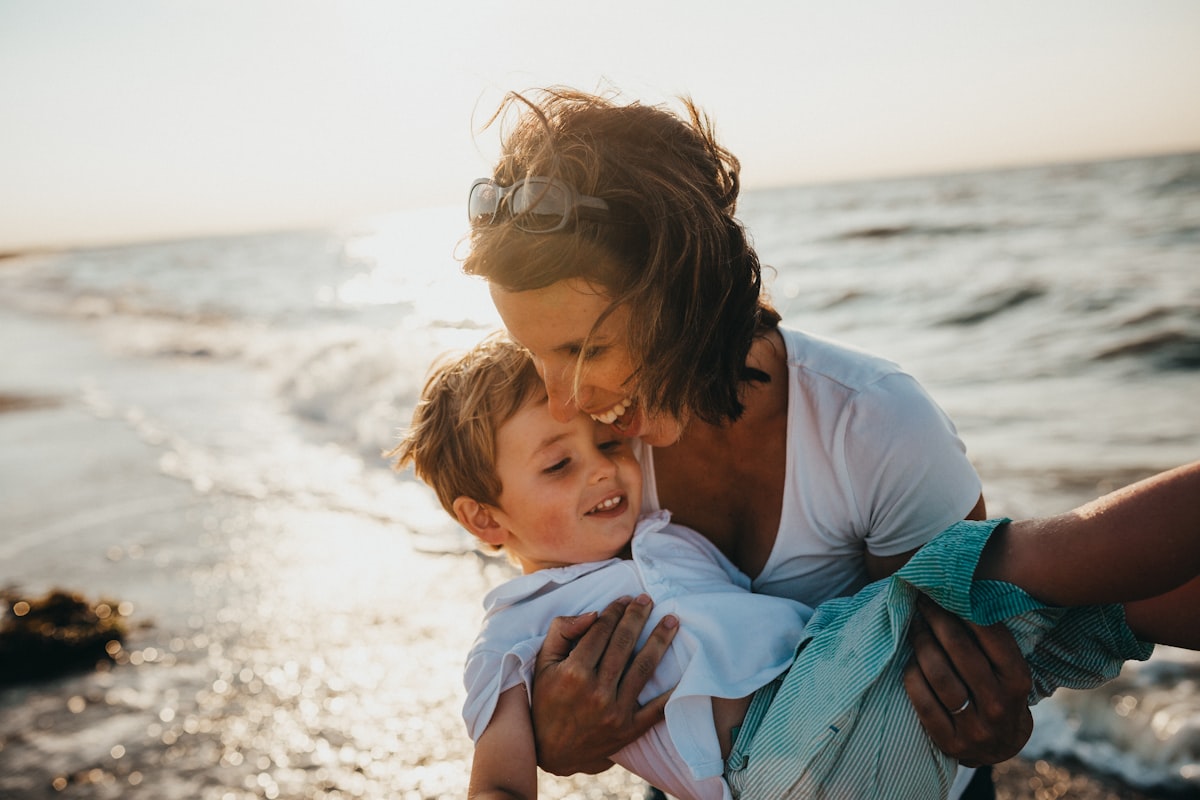
Morning preparation:
- Apply SPF 30+ mineral sunscreen to all family members 30 minutes before leaving home
- Pack: hat for each family member, sunscreen (enough to reapply every 80 minutes), rash guards for children
- Check SunUp: enter Beach/Swimming activity, set each family member's skin type, check UV forecast
At the beach:
- Set up camp under an umbrella — but note: umbrellas don't block reflected UV from sand (30-40% of UV bounces back under umbrellas)
- Reapply sunscreen every 80 minutes, more frequently after swimming
- Take midday shade breaks (11 AM–1 PM) — even 30 minutes in shade significantly reduces total dose
- Rash guards in the water are more effective than sunscreen in the water — especially for kids
Monitoring SunUp during the day:
- Open SunUp and check "Time remaining" to see how long your planned activity duration has left at safe exposure levels
- The app will notify you when it's time to reapply or seek shade
Checking UV Safety for Your Family with SunUp
SunUp's "Plan for Someone Else" feature lets you run a complete personalized UV check for any family member — your child, partner, parent, or anyone else. Here's how:
- Open SunUp and go to the Activity Planner
- Tap Plan for Someone Else
- Enter their name and choose your relationship (child, partner, family member, friend)
- Enter their age and gender (age affects UV sensitivity — children get more conservative estimates)
- Select their Fitzpatrick skin type using the visual guide
- Set the location — your current GPS location, or search by city or address anywhere in the world
- SunUp calculates their personalized safe exposure time based on their specific details
Planning a beach day for your fair-skinned Type II child versus your Type IV partner? Each gets a different safe-time recommendation based on their biology. You can check for one person, then tap "Plan for Someone Else" again to check for the next.
Note: This is a one-time check per person — SunUp doesn't save persistent profiles for family members yet. Saved multi-person family profiles are coming in a future update.
The Statistics Every Parent Should Know
- 1 in 5 Americans will develop skin cancer by age 70
- 5+ sunburns in childhood doubles lifetime melanoma risk
- 90% of nonmelanoma skin cancers are associated with UV exposure
- Melanoma is the most common cancer in young adults aged 25–29
- Early detection saves lives: 5-year survival rate for localized melanoma is 99%; it drops to 35% for distant-stage melanoma
These numbers aren't meant to frighten — they're meant to motivate action. And the good news is that consistent sun protection during childhood and adolescence dramatically reduces these risks.
Practical Family Sun Safety: The Non-Negotiables
After all the nuance above, the core practices that matter most:
- Broad-spectrum SPF 30+ sunscreen applied 20 minutes before outdoor time
- Wide-brim hats for all family members during peak UV hours (10 AM–2 PM)
- UPF 50+ clothing as the primary protection layer for active children
- Reapply sunscreen every 80 minutes and after swimming
- Use SunUp's "Plan for Someone Else" to check personalized UV safety for each family member
That's the foundation. Everything else is optimization.
Download SunUp and use "Plan for Someone Else" to give every member of your family personalized UV protection guidance — no accounts or setup required.
FAQ
What sunscreen is best for kids?
Mineral sunscreens using zinc oxide or titanium dioxide are the first-line recommendation for children. They start working immediately, have lower allergy and irritation risk than chemical formulas, and are safe for sensitive infant and toddler skin. Look for SPF 30+ (97% UV-B protection), fragrance-free formulas, and water-resistant (80 minutes) ratings for active kids who sweat and swim. Avoid oxybenzone for children under 6.
What SPF should a child use?
SPF 30 is the minimum for any child spending time outdoors. SPF 50 is worth it for beach days, water play, or extended outdoor activity — children are active, sweat constantly, and the extra margin of protection accounts for the inevitable underapplication. Reapplication every 80 minutes is more important than SPF number for active kids.
How young can a baby be to wear sunscreen?
The American Academy of Pediatrics recommends keeping infants under 6 months out of direct sunlight entirely and avoiding sunscreen use (their skin is too sensitive). From 6 months onward, a mineral sunscreen (zinc oxide or titanium dioxide) can be applied to exposed areas. Always patch test first on a small area of skin to check for reaction.
How do you get kids to wear sunscreen?
Make it part of the routine before outdoor activities — same timing every time, non-negotiable. Let them choose their own sun hat (buy-in through choice matters). Frame sunscreen as just "what we do before going outside," not a reaction to UV being dangerous. For teenagers, connecting sun protection to appearance (preventing premature aging, dark spots) tends to work better than health messaging.
Why does children's skin need more sun protection than adults'?
Children's skin has a thinner dermis, more active melanocytes, and less mature DNA repair systems than adult skin. UV penetrates proportionally deeper relative to skin thickness. More importantly, children have 70+ years of UV accumulation ahead of them — early protection compounds in their favor over their entire lifetime. And 5+ blistering sunburns before age 20 doubles lifetime melanoma risk — a statistic that makes childhood protection one of the highest-leverage health decisions a parent makes.
Apply This Knowledge With SunUp
Get real-time UV data personalized for your skin type, location, and activity.
Download Free — iOS