
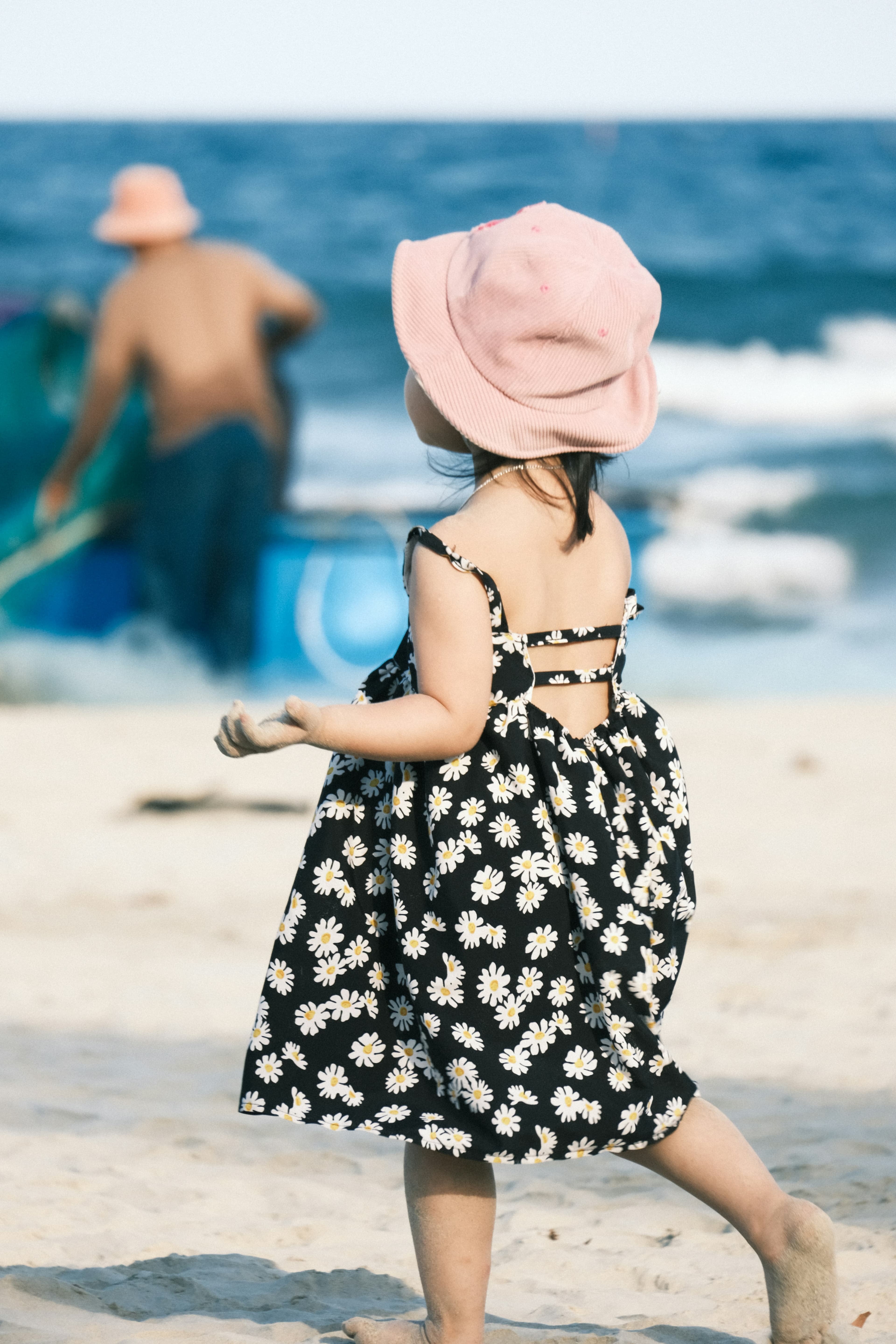

The debate usually sounds like this: "I put on sunscreen." "We sat in the shade." "She had her hat on."
All three are real protection. None of them is the full story.
What actually protects children from UV radiation isn't a single product — it's understanding how each tool works, what it covers, and what it misses. Because hats, sunscreen, and shade each have blind spots. And when you rely on any one of them alone, you're working with a protection gap you probably don't know is there.
Quick Answer: Hats, sunscreen, and shade all reduce UV exposure in children — but through completely different mechanisms, covering different body areas, with different failure modes. A wide-brim hat protects what nothing else does: face, neck, and eyes simultaneously. UPF 50+ clothing is the most reliable protection for covered skin. Sunscreen fills in the gaps. Shade helps, but open shade still carries significant UV. The strongest protection uses all of them together.
How Sunscreen Actually Works
Sunscreen either absorbs UV radiation (chemical sunscreens) or physically reflects it (mineral sunscreens with zinc oxide or titanium dioxide). What it does not do is create a long-lasting invisible barrier that stays active all day.
SPF is measured in laboratory conditions at exactly 2mg per square centimeter of skin — roughly a full teaspoon for a child's face and neck alone, or about half an ounce for the full body. Most people apply 25–50% of this amount, which dramatically reduces effective protection. Half-applying SPF 30 gives you roughly SPF 5.
For children, there are additional layers of failure: it wipes off, it washes off in water, it gets in eyes if not applied carefully, and convincing an active child to stay still for reapplication every 90 minutes is its own challenge.
Sunscreen is genuinely important — but it works best as one layer of a larger system, not as the whole system.
When sunscreen does its job: Face, neck, ears, and hands — the skin that clothing doesn't cover. Applied correctly before going out and reapplied on schedule.
Where sunscreen fails: Application errors are nearly universal. Missed areas (ears, back of neck, tops of feet) are common. No sunscreen actually provides all-day protection from a single morning application.
How UPF Clothing Works
UPF stands for Ultraviolet Protection Factor. Where SPF measures protection from UV-B (the burning rays), UPF measures protection from both UV-A and UV-B passing through fabric.
The number tells you the fraction of UV that gets through. Research from UCSF Benioff Children's Hospitals confirms that a fabric with a minimum UPF of 20 allows only 1/20th of UV radiation to pass. A UPF 50+ garment lets through just 1/50th — 2%.
For context: a plain white cotton T-shirt has a UPF of around 5–7, letting through 15–20% of UV. When a child wears a white T-shirt in strong sun, they're getting meaningful UV exposure through the fabric itself. Wet fabric performs even worse — when a cotton T-shirt gets wet, UPF can drop to around 3.
A few other things the research shows about fabric UV protection:
- Dark and bright colors absorb more UV than white or light-colored fabrics
- Tightly woven fabrics outperform loosely woven ones regardless of color
- Synthetic fabrics (polyester, nylon) generally outperform natural fibers at the same weight
- A wet rash guard performs far better than a wet cotton shirt
UPF 50+ clothing is the most consistent form of UV protection for the skin it covers. It doesn't depend on reapplication. It doesn't depend on a child sitting still. It doesn't wear thin over the day.
The main limitation: it only covers what it covers. Exposed skin still needs sunscreen.
How Wide-Brim Hats Work
Here's what no other sun protection item does: simultaneously shade the face, neck, and eyes with a single piece of gear.
Sunscreen doesn't reach inside the eye. Clothing leaves the head exposed. A standard baseball cap shades the face and forehead, but leaves the ears, back of the neck, and the sides of the head uncovered — areas that receive direct sun during most outdoor activities.
A wide-brim hat with a brim of at least 3 inches (roughly 7.5cm) all the way around provides:
- Face coverage — nose, cheeks, forehead
- Ear coverage — frequently burned in children, often missed by sunscreen
- Neck coverage — back and sides of the neck
- Eye shading — reducing UV entering the eyes from above
The eye protection component matters more than most parents realize. Research from UCSF Benioff Children's Hospitals indicates that up to 80% of lifetime UV exposure to the eyes occurs before age 18. UV eye damage contributes to cataracts and macular degeneration later in life — conditions that show up in your 50s and 60s but were being built in childhood.
A proper wide-brim hat doesn't eliminate eye UV (UV reflects from below, from sand and water and pavement), but it dramatically reduces the direct overhead UV reaching the eye.
For children especially: A hat that actually stays on their head is the most important criteria. Chin straps, adjustable sizing, and lightweight materials all help. A hat in a bag is not protecting anyone.
GearTOP Kids Sun Hats
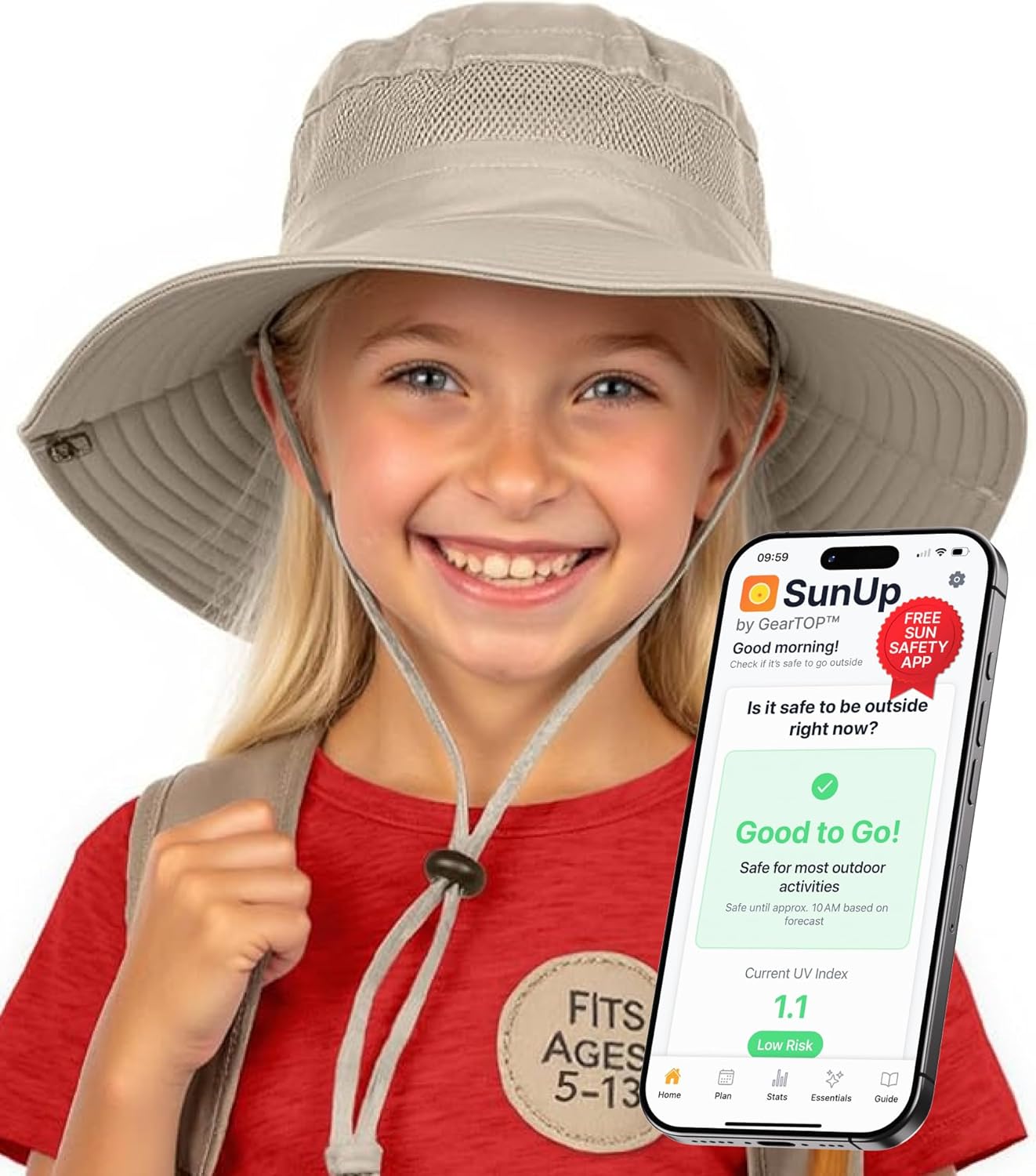
GearTOP makes wide-brim sun hats designed specifically for UV protection with UPF-rated fabric. The kids' hats have adjustable chin straps to stay on in wind and during active play.
GearTOP Kids Sun Hat — Shop Now:
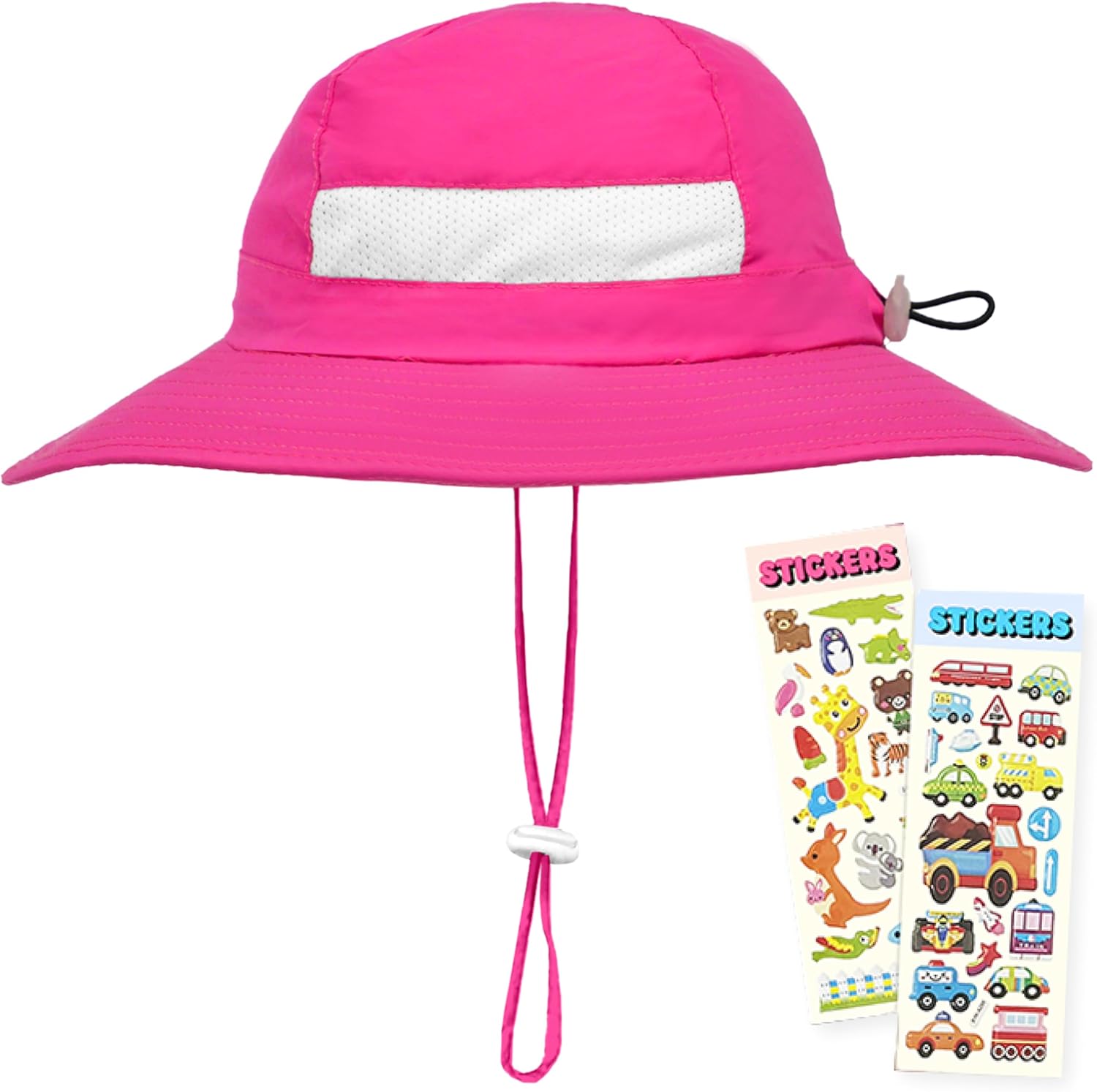
For younger children (toddlers), the UPF 50+ bucket-style hat with adjustable sizing:
GearTOP Adult Sun Hats (for parents who want the same protection):
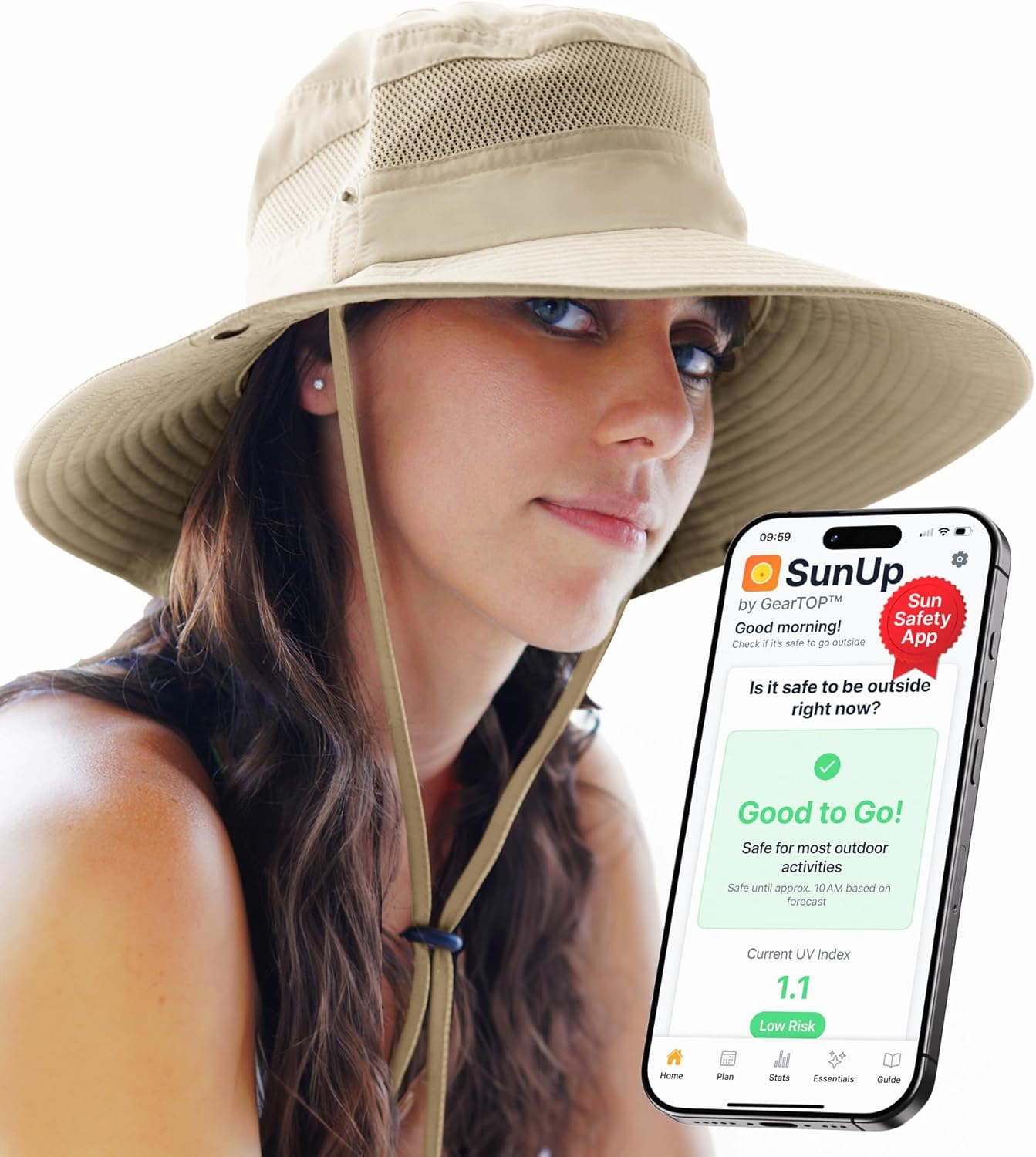
The wide-brim boonie-style Navigator hat for adults has a 3.5-inch brim with mesh ventilation panels — the same wide-coverage design, built for all-day outdoor wear.
How Shade Works (and Doesn't)
Shade is often treated as the complete solution: "We sat in the shade, so they were fine."
Shade from a solid structure — an indoor space, a UV-blocking canopy, a large tree with dense foliage — does meaningfully reduce UV. Full shade under a UV-blocking beach umbrella can cut direct UV by 75–95%.
But open shade has a problem: reflected UV.
UV radiation reflects off surfaces and reaches people in the shade. The reflection rates are significant:
- Sand: reflects 25% of UV
- Concrete/pavement: 10–15%
- Water: up to 25% depending on angle
- Snow: up to 80% (relevant for winter and early spring)
- Grass: around 3%
A child sitting under an umbrella at the beach is still receiving roughly 25% of the beach's UV load bouncing off the sand around them. They're protected from direct overhead sun but not from reflected UV on the lower face, neck, and exposed arms.
Shade works best as a timing strategy — reducing peak UV exposure by being in deeper shade during the 11am–2pm window when UV index peaks, combined with other protective layers rather than instead of them.
The Layered Approach: Why All Three Together
Each layer covers a different failure mode of the others.
| Layer | What it covers well | What it misses |
|---|---|---|
| UPF 50+ clothing | Covered skin — consistent, all-day | Exposed face, neck, hands |
| Wide-brim hat | Face, neck, ears, eyes | Everything below the hat |
| Sunscreen | All exposed skin | Requires correct application + reapplication |
| Shade | Reduces total UV dose | Doesn't eliminate reflected UV |
The layered approach means that when one layer has a failure — sunscreen that wasn't reapplied on time, a hat that blew off, partial shade — the others are still working.
A practical routine that actually works:
- Start with clothing — UPF 50+ swim shirt or long-sleeve top for prolonged sun exposure
- Add the hat — Wide brim, chin strap, at least 3 inches all around
- Apply sunscreen to exposed skin — Face, neck, ears, hands. A teaspoon for the face and neck alone
- Pick the timing — Schedule peak outdoor time (beach, long hike, tournament) for before 10am or after 3pm when possible
- Reapply sunscreen — Set a timer for 90 minutes. It will feel unnecessary until the day you skip it
When to Use Each Approach
Short outdoor exposure (under 30 minutes at UV index under 5): Hat and shade are often sufficient. Brief UV exposure at low index.
Moderate outdoor time (30–90 minutes, UV index 5–7): Hat + sunscreen on exposed skin. Consider UPF top for children who tend not to reapply.
Long outdoor exposure (90+ minutes, UV index 7+): All three. UPF clothing + wide-brim hat + sunscreen on exposed areas + shade breaks during peak UV. Reapplication is mandatory, not optional.
Water activities: UPF 50+ rash guard + waterproof sunscreen reapplied after every water exit. "Water resistant" sunscreen is not waterproof — reapply.
All of these work. But none of them tell you when you need them. The UV index this morning at your exact location, right now, for your child's skin type — that's what determines whether you need the full routine or whether a hat is enough.
That's what SunUp is built for. Real-time UV index. Personalized burn time by skin type. Activity duration. All in one place, every day.
FAQ
Is sunscreen or UPF clothing better for kids?
Both protect differently and work best together. UPF 50+ clothing blocks UV mechanically — it doesn't wash off, doesn't need reapplying, and doesn't depend on application technique. Sunscreen covers skin that clothing doesn't reach (face, neck, hands) but requires correct application and reapplication every 80–120 minutes to maintain rated protection. Neither alone is as effective as both together.
What does UPF 50 mean on children's clothing?
UPF (Ultraviolet Protection Factor) measures how much UV radiation a fabric allows through. UPF 50 means only 1/50th — or 2% — of UV radiation penetrates the fabric. A plain white cotton T-shirt typically has a UPF of around 5–7, meaning it lets through 15–20% of UV radiation. UPF 50+ is the highest rating and is appropriate for direct prolonged sun exposure.
How wide does a kids' hat brim need to be to protect from UV rays?
Dermatologists generally recommend a brim of at least 3 inches (7.5cm) all the way around for meaningful protection of the face, ears, and neck. A baseball cap only shades the face and front of the head — it leaves the ears, back of the neck, and sides exposed. A wide-brim hat with a full circumference brim is the most comprehensive single item for protecting children's faces, necks, and eyes from UV.
Does shade fully protect kids from UV rays?
No — shade reduces but does not eliminate UV exposure. Reflected UV from sand, water, concrete, and snow reaches children even when they are under an umbrella or in the shadow of a building. Sand can reflect up to 25% of UV radiation; fresh snow up to 80%. Full shade (under a UV-blocking canopy or indoors) provides much greater protection than partial shade, but open shade without physical barriers still carries UV risk.
What SPF sunscreen should I use on my child?
SPF 30–50 broad-spectrum (protecting against both UV-A and UV-B) is appropriate for most children. Above SPF 50, the additional protection is minimal — SPF 100 blocks 99% of UV-B vs SPF 50's 98%. More important than the SPF number: applying the correct amount (roughly a teaspoon for the face and neck) and reapplying every 80–120 minutes during outdoor activity, or immediately after swimming or heavy sweating.
At what UV index does my child need sun protection?
UV protection is recommended whenever the UV index reaches 3 or above — which is moderate. At UV index 3, a fair-skinned child can begin accumulating damage in as little as 30–45 minutes without protection. At UV index 8 (very high), that can be 10–15 minutes. The SunUp app gives you a real-time UV index and personalized safe time estimate based on your child's skin type.
Apply This Knowledge With SunUp
Get real-time UV data personalized for your skin type, location, and activity.
Download Free — iOS