
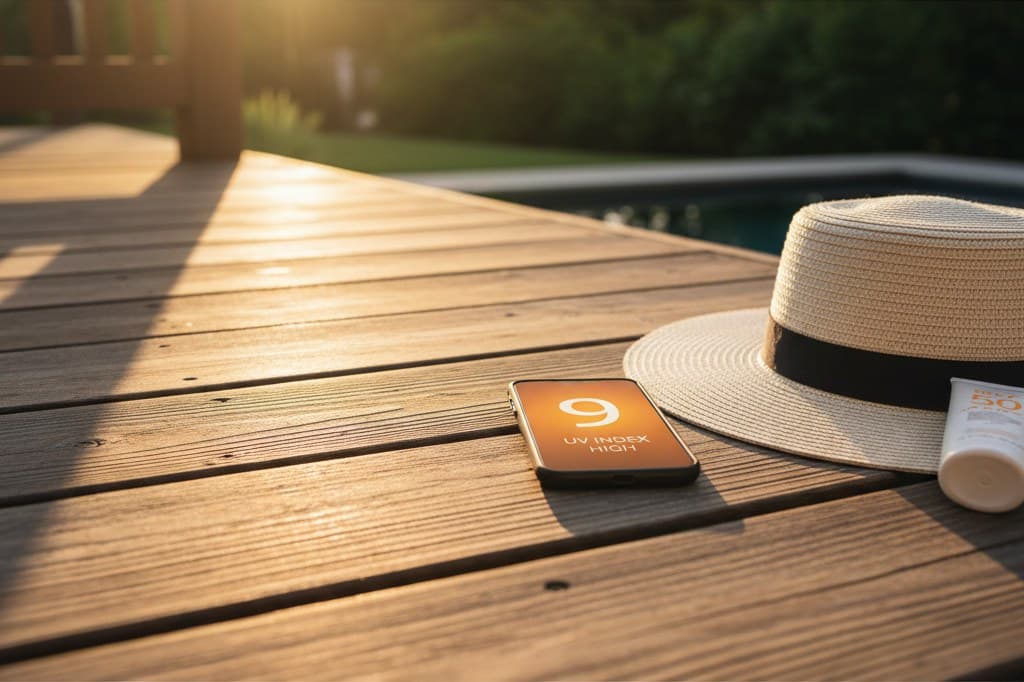

How long does it take to burn by UV index? For very fair skin, it can be about 35–55 minutes at UV 3–4, 18–28 minutes at UV 5–6, 11–18 minutes at UV 7–9, and 8–12 minutes at UV 10–11 without protection. Fair, medium, olive, brown, and dark skin take longer — but the same UV index can mean very different burn times for different people.
The chart below gives a planning baseline. Your real number shifts with skin type, age, altitude, water or pavement reflection, cloud cover, time of day, sunscreen habits, and your exact location.
Quick burn time chart by UV index
| UV Index | Risk level | Very fair skin | Fair skin | Medium skin | Brown/dark skin |
|---|---|---|---|---|---|
| 3–4 | Moderate | 35–55 min | 50–70 min | 75–100 min | 2.5+ hrs |
| 5–6 | High | 18–28 min | 22–33 min | 30–44 min | 60+ min |
| 7–9 | Very High | 11–18 min | 17–22 min | 25–35 min | 50+ min |
| 10–11 | Extreme | 8–12 min | 13–18 min | 20–27 min | 38+ min |
| 12+ | Extreme | 6–9 min | 10–14 min | 15–21 min | 30+ min |
Use this as a warning range, not permission to stay out until the last minute. SunUp personalizes the estimate using your profile and current conditions, then shows the safer window for today.
If the search in your head is "how long does it take to burn in UV 6, 7, 8, 9, or 10?" — start with the table, then adjust down if you're near water, sand, snow, concrete, altitude, or broken cloud.
What Burn Time Actually Means
Burn time is the estimated number of minutes it takes for unprotected skin to show visible redness (erythema) — the first sign of sunburn. Dermatologists call the threshold the Minimal Erythemal Dose, or MED. One MED = the UV dose that produces barely perceptible redness 24 hours after exposure, and it's normally measured clinically — it varies person to person.
There's no single official public formula for converting UV index straight into burn-time minutes. What follows is a commonly used estimation approach built around relative skin-type sensitivity — useful for planning, not a clinical guarantee:
Rough estimate: Safe Minutes ≈ (Skin Type Multiplier × 200) ÷ (3 × UV Index)
Skin type multipliers (relative sensitivity, not an official clinical scale):
| Skin Type | Description | Multiplier | Typical Features |
|---|---|---|---|
| Type I | Very fair | 2.5 | Pale skin, red/blonde hair, freckles, always burns |
| Type II | Fair | 3.0 | Fair skin, light hair, blue/green eyes, burns easily |
| Type III | Medium | 4.0 | Light brown/olive, brown hair, sometimes burns |
| Type IV | Olive | 5.0 | Olive/light brown, dark hair, rarely burns |
| Type V | Brown | 8.0 | Brown skin, dark hair/eyes, very rarely burns |
| Type VI | Dark | 15.0 | Dark brown/black skin, almost never burns |
At UV index 6 with Type II skin: (3 × 200) ÷ (3 × 6) = roughly ~33 minutes — in the same range as independently published burn-time charts for that skin type and UV level.
That's an estimate for planning. It's not a guarantee, and it's not a substitute for a number based on your actual skin and location — which is what checking your Fitzpatrick type and an app like SunUp are for.
The Burn Time Chart — UV Index × Skin Type
Here's what the numbers look like across the full range. These are unprotected estimates — no sunscreen, no shade, no hat.
| UV Index | Risk Level | Type I | Type II | Type III | Type IV | Type V | Type VI |
|---|---|---|---|---|---|---|---|
| 1–2 | Low | 80+ min | 100+ min | 2+ hrs | 3+ hrs | 4+ hrs | 8+ hrs |
| 3–4 | Moderate | 35–55 min | 50–70 min | 75–100 min | 110–140 min | 2.5–3.5 hrs | 5–6 hrs |
| 5–6 | High | 18–28 min | 22–33 min | 30–44 min | 37–56 min | 60–89 min | 2–3 hrs |
| 7–9 | Very High | 11–18 min | 17–22 min | 25–35 min | 36–47 min | 50–76 min | 85 min–2 hrs |
| 10–11 | Extreme | 8–12 min | 13–18 min | 20–27 min | 28–37 min | 38–50 min | 50–65 min |
| 12+ | Extreme | 6–9 min | 10–14 min | 15–21 min | 22–28 min | 30–40 min | 40–50 min |
Look at the Type I column at UV index 10: 8–12 minutes. That's a single trip to the mailbox, a quick walk to the car, or standing outside waiting for an Uber. You don't need to be at the beach.
Why Burn Time Isn't One Number
The formula gives you a baseline. Reality throws in variables that can cut your actual burn time in half.
Altitude
UV increases roughly 4–5% for every 1,000 feet of elevation, a figure commonly cited by skin cancer prevention groups. At 8,000 feet — the elevation of many Colorado ski towns — you're getting roughly 30–40% more UV than at sea level. That 33-minute burn time at UV 6 becomes more like 20 minutes. Sun safety at altitude covers this in more depth for hikers.
Surface Reflection
The ground bounces UV back at you (source, WHO):
- Snow: reflects up to 80% of UV — nearly doubles your exposure
- White sand: up to 12% reflection
- Water: up to 5%, but more at low sun angles
- Concrete/pavement: up to 12%
- Grass: up to 5%
On a boat at midday, you're getting UV from above and below. Your face is shaded by the hat brim? Your chin and neck are still getting it from the water reflection. Burn time — cut down, sometimes significantly.
Cloud Cover
This is the one that catches people. Per WHO/ICNIRP guidance, up to 80% of UV still gets through light cloud cover. Broken, partly cloudy skies can even push UV-B briefly above clear-sky levels through cloud-edge scattering. You feel cool. You don't feel the sun. And you stay out three times longer than you would on a clear day — burning the whole time.
Time of Day
The UV index peaks at solar noon — typically between 11am and 2pm in summer, depending on your time zone and daylight saving. A UV index of 8 at noon might be 4 at 4pm. Same day, same skin, double the burn time. The SunUp app shows a UV forecast curve for the whole day so you can plan around the peak.
Four factors that shrink the chart's baseline burn time: altitude, ground reflection, cloud cover, and time of day all stack on top of your skin type — which is why an app checking your real conditions beats a static chart. See the full UV 9 burn-time breakdown for extreme-UV numbers by skin type.
How SunUp Calculates Your Personal Burn Time
The problem with burn time charts is that you have to:
- Know the current UV index
- Know your Fitzpatrick skin type
- Do the math or look up a table
- Adjust for altitude, reflection, and cloud effects
Nobody does that. People guess. And they guess wrong — usually in the optimistic direction.
The SunUp app (free on iOS) does all of this automatically. It pulls your GPS location, checks the real-time UV index, and calculates your personal burn time based on your skin type. You open the app, it says "UV index 7 — you have 22 minutes unprotected." That's something you can actually use.
It also shows the UV forecast for the day, so you can see when the peak hits and schedule outdoor time around it. If UV peaks at 1pm, go for your run at 9am or 5pm instead.
What to Do With Your Burn Time Number
Knowing your burn time is useful because it changes how you behave:
If your burn time is under 30 minutes: You need protection for anything more than a quick errand. A UPF 50+ wide-brim hat covers your face, ears, and neck without reapplication. Sunscreen everywhere else. Reapply every 2 hours.
If your burn time is 30–60 minutes: Sunscreen is still non-negotiable for extended outdoor time. A hat lets you stop worrying about the hardest-to-protect areas.
If your burn time is 60+ minutes: You have more margin, but UV damage is cumulative. Repeated blistering sunburns — especially in childhood — are linked to a significantly higher lifetime melanoma risk; some research puts five or more blistering burns at roughly an 80% increase. Margin isn't immunity.
The hat is the easiest win. Fabric doesn't sweat off. It doesn't need reapplication. You put it on, it blocks UV. Combine a UPF 50+ hat from GearTOP with the SunUp app and you've got real-time risk awareness plus physical protection — without having to think about it every time you step outside.
FAQ
What is UV index burn time?
UV index burn time is the estimated number of minutes it takes for unprotected skin to start reddening at a given UV index level. It varies dramatically by skin type. Very fair skin (Type I) can burn in under 10 minutes at UV index 11 — dark skin (Type VI) may take over an hour at the same UV level.
How is burn time calculated?
Burn time uses the Minimal Erythemal Dose (MED) formula: Safe Minutes = (200 × Skin Type Multiplier) ÷ (3 × UV Index). Skin type multipliers: Type I = 2.5, Type II = 3, Type III = 4, Type IV = 5, Type V = 8, Type VI = 15. This gives you an estimate — altitude, surface reflection, and cloud scattering can all reduce real-world burn time significantly.
How long does it take to burn at UV index 6?
At UV index 6 (High), approximate unprotected burn times: Type I ~18 minutes, Type II ~22 minutes, Type III ~30 minutes, Type IV ~37 minutes, Type V ~60 minutes, Type VI ~120 minutes. These are estimates — if you're near water or at altitude, actual burn times are shorter.
What UV index burns the fastest?
UV index 11+ (Extreme) produces the fastest burns. At UV 11, very fair skin (Type I) can burn in 6–9 minutes unprotected. At UV 13+, that drops to 6 minutes or less. Even Type VI skin needs protection at these levels — burn time drops to 40–50 minutes.
Does SPF change burn time?
Yes — in theory. SPF 30 extends burn time by 30× if applied perfectly: 10 minutes unprotected becomes 300 minutes. In practice, most people apply too little (about 25–50% of the recommended amount) and don't reapply, so actual protection is closer to SPF 10–15. A UPF 50+ hat removes the guesswork for covered areas entirely.
Can you burn in 10 minutes?
Yes. At UV index 9+, very fair skin (Type I–II) can start burning in 8–12 minutes without protection. At UV index 11+, even medium skin (Type III) can burn in under 20 minutes. This is why midday sun protection matters — UV peaks between 10am and 4pm.
Why does burn time vary by skin type?
Skin type determines how much melanin your skin produces as natural UV protection. Type I skin produces almost no melanin and burns quickly. Type VI skin has high melanin levels and burns much more slowly. The Fitzpatrick scale (Types I–VI) is the standard dermatological classification used to estimate burn time. Note that even Type VI skin can burn at high UV levels — melanin is protection, not immunity.
Is the UV index the same as burn time?
No. The UV index measures UV radiation intensity at ground level — it's the same for everyone. Burn time is personal — it depends on your skin type, altitude, surface reflection, and whether you're in shade. Two people at the same UV index can have completely different burn times. That's why an app like SunUp that calculates your personal number is more useful than a weather app that just shows the UV index.
Don't guess your burn time. Download SunUp free on iOS to get your personal UV index and burn time for your exact location, and grab a GearTOP UPF 50+ hat for protection that doesn't wash off.
Apply This Knowledge With SunUp
Get real-time UV data personalized for your skin type, location, and activity.
Download Free — iOS