

If you searched “UV 9 burn time,” “UV 9 tan time,” “10 minutes in UV 9,” or “30 minutes in UV 9,” here is the useful answer: UV 9 is very high. Very fair skin can start burning in about 11–15 minutes, fair skin in about 17–23 minutes, medium skin in about 25–35 minutes, and darker skin may have roughly 65–85 minutes or more before visible burn.
For tanning, the safer answer is stricter: do not use UV 9 as a tanning window. A tan is still UV damage, and at UV 9 the margin between “a little color” and a painful burn is short — especially for kids, fair skin, reflective settings, and anyone using photosensitizing medication.
Those numbers are not your number.
Your real burn time changes with your age, skin type, exact location, today's UV index, and reflection from water, sand, snow, or pavement. Kids burn differently than adults. Older skin reacts differently too. If your child is at camp, your parent is away for the weekend, or you're planning Saturday soccer, check the actual location and profile — not a generic chart.
Quick Answer: At UV 9, unprotected burn time can be as short as 11–15 minutes for very fair skin. For many people, 10 minutes is already meaningful exposure; 20 minutes can burn fair skin; 30 minutes is high-risk without protection; and 60 minutes should be treated as a full-protection situation. Use the table below for context, then check your personal SunUp number for your skin, age, location, reflection, and 8-day forecast.
UV 9 Burn Time: The Answer Searchers Actually Need
At UV 9, the question should not be “how long should I tan?” It should be “how quickly do I need protection?”
| UV 9 search | What it means in real life | Safer move |
|---|---|---|
| 10 minutes in UV 9 | Very fair skin can be close to burn territory; fair skin is already accumulating meaningful UV. | Cover face/neck, use sunscreen, and do not extend just because 10 minutes feels short. |
| 20 minutes in UV 9 | Fair skin can burn; medium skin may be approaching the risky part of the window. | Treat this as protected exposure, not casual tanning time. |
| 30 minutes in UV 9 | High-risk for Type I–III skin without protection; enough for damage even before redness shows. | Use SPF, UPF clothing, and shade breaks. Check your personal burn timer. |
| 60 minutes in UV 9 | Too long to manage by “feel.” Sweat, water, and missed sunscreen spots matter. | Plan reapplication and physical shade before you go out. |
UV 9 Burn Time by Skin Type
| Skin type | Approx. unprotected burn time at UV 9 | Approx. tan-time example | Practical takeaway |
|---|---|---|---|
| Type I — very fair | 11–15 minutes | Not recommended | Avoid intentional tanning; protection before exposure. |
| Type II — fair | 17–23 minutes | Not recommended | Short outdoor windows can still burn. |
| Type III — medium | 25–35 minutes | ~10–15 minutes before risk rises | More margin, but still high-risk UV. |
| Type IV — olive | 36–47 minutes | ~15–25 minutes before risk rises | Damage accumulates even before redness. |
| Type V — brown | 50–65 minutes | ~25–35 minutes before risk rises | Lower visible burn risk, not zero UV risk. |
| Type VI — dark | 65–85+ minutes | ~35–50 minutes before risk rises | Longer burn window, but eyes and cumulative exposure still matter. |
If you're trying to tan in UV 9, the safest move is to shorten the exposure, avoid midday, use SPF, and cover your face, ears, and neck with UPF gear. SunUp is useful here because it turns the generic UV 9 into a personal number for the person and place you actually care about.
What this means in real life: your number, your child's number, and your parent's number can all be different on the same afternoon. SunUp lets you check a saved family profile remotely, change the location, and look up to 8 days ahead before camp, a beach day, a hike, or a weekend game. That is the useful version of a UV 9 burn-time chart: not one internet answer, but the answer for the person you are actually protecting.
One UV index, three different burn-time windows: the same UV 9 reading produces a different safe-exposure number for an adult, a child, and an older parent, based on each person's skin profile.
Unprotected Safe Time by Skin Type and UV Index
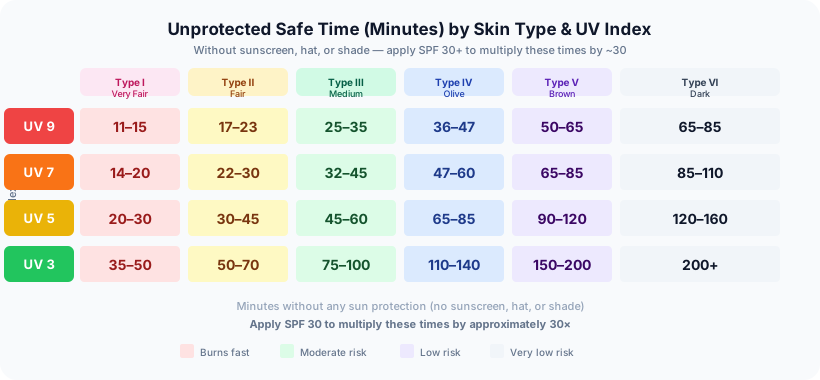
This table shows approximate minutes before UV exposure starts causing skin damage — without sunscreen, hat, or shade. These are based on the standard Fitzpatrick skin type model used in dermatology worldwide.
Treat it like a map, not a stopwatch. The table does not know whether you're 8 or 78, standing beside Lake Ontario, sitting on a white-sand beach, hiking at altitude, or checking on a family member in a different city. SunUp is built for that personal layer: check daily for yourself, check remotely for people you care about, and look ahead up to 8 days when you're planning an outdoor event.
| UV Index | Type I (Very Fair) | Type II (Fair) | Type III (Medium) | Type IV (Olive) | Type V (Brown) | Type VI (Dark) |
|---|---|---|---|---|---|---|
| 3 | 35–50 min | 50–70 min | 75–100 min | 110–140 min | 150–200 min | 200+ min |
| 5 | 20–30 min | 30–45 min | 45–60 min | 65–85 min | 90–120 min | 120–160 min |
| 7 | 14–20 min | 22–30 min | 32–45 min | 47–60 min | 65–85 min | 85–110 min |
| 9 | 11–15 min | 17–23 min | 25–35 min | 36–47 min | 50–65 min | 65–85 min |
| 11 | 8–12 min | 13–18 min | 20–27 min | 28–37 min | 38–50 min | 50–65 min |
| 13+ | 6–9 min | 10–14 min | 15–21 min | 22–28 min | 30–40 min | 40–50 min |
A few important things about this table:
These are without any protection. No sunscreen, no hat, no protective clothing.
These are minimums. Some people within each type burn faster. If in doubt, use the lower number.
UV index 9–11 is completely normal in summer across much of the US, Canada, southern Europe, and anywhere south of 40° latitude. UV 13+ happens regularly in Florida, Hawaii, the Caribbean, and anywhere in Central or South America year-round.
After sunscreen: SPF 30 multiplies your time by roughly 30. A Type II person with 22 minutes of unprotected time at UV 9 gets approximately 660 minutes (11 hours) of protected time with properly applied SPF 30. This is theoretical — reapplication, sweat, and missed spots mean the real-world number is lower. But the principle holds: SPF makes an enormous difference.
What Type Are You?
The Fitzpatrick Scale classifies skin into six types based on how it responds to UV radiation — not just how it looks.
Type I — Very pale, often with freckles. Red or blonde hair. Blue or green eyes. Always burns severely, never tans. Typical in people of Irish, Scottish, or Scandinavian ancestry.
Type II — Fair skin, may have some freckles. Light hair. Burns easily, tans minimally. Most people of Northern/Western European ancestry who aren't Type I.
Type III — Light to medium skin. Brown hair. Sometimes burns, always tans. Many people of Southern European, Middle Eastern, or East Asian descent.
Type IV — Olive or light brown skin. Dark hair. Rarely burns, tans easily. Many people of Mediterranean, Hispanic, or South Asian heritage.
Type V — Medium to dark brown skin. Almost never burns. Many people of Middle Eastern, South Asian, and some East Asian heritage.
Type VI — Dark brown to black skin. Never burns in any practical sense. Very rare sun damage from short-term exposure. Many people of sub-Saharan African heritage.
Not sure which type you are? Go with how your skin actually behaves in the sun, not just how it looks. If you burn when you don't expect to, you're probably a lighter type than you think. When in doubt, use the more conservative (lower) time estimate.
What Changes These Numbers
The table above is a baseline. Several factors push your actual safe time up or down significantly.
Altitude
UV intensity increases 10–12% per 1,000 metres of elevation gain. A hike at 3,000 metres means you're getting 30–40% more UV than someone at sea level under the same UV index forecast. That 3,000m UV index shown in your weather app was measured at sea level — the actual UV hitting you on the trail is significantly higher.
At Machu Picchu (2,430m), UV routinely hits 15–20. The Rockies, Alps, and Sierras regularly expose hikers to UV 10–14+ during summer. If you're hiking or skiing at elevation, read our full guide to sun safety for hikers and trail runners.
Snow and Sand Reflection
UV reflects off surfaces and hits you from below — not just above.
Snow reflects up to 80% of UV back at you. This is why skiers get badly sunburned on their face, chin, and neck even while facing directly away from the sun. Effective UV exposure at a ski resort can be nearly double what the UV index suggests.
White sand reflects 15–25%. You're getting UV from the sky above and the sand below simultaneously. Sitting under a beach umbrella doesn't help as much as you'd think — the reflected UV comes in from below the umbrella.
Grass reflects only 2–3%. A park picnic is dramatically lower UV exposure than the same UV index at a beach.
Cloud Cover
Thin or broken cloud cover barely reduces UV — sometimes by less than 20%. Many people get their worst burns on "overcast" beach days because they skip sunscreen when they can't see blue sky.
Thick, complete cloud cover reduces UV by 50–80%. But this is unusual in summer weather patterns.
The practical rule: if you can see your shadow at all, UV is reaching you at meaningful levels.
Medication and Photosensitivity
Some common medications make skin dramatically more UV-sensitive. This isn't obscure — it includes antibiotics (doxycycline, tetracyclines), diuretics, some antidepressants, and certain NSAIDs. The FDA's guidance on drug photosensitivity covers which classes of medications are most commonly implicated. If you're on any of these, the times in the table above are significantly shorter for you. Your pharmacist can tell you if your current medications affect UV sensitivity.
Age
Children's skin is more UV-sensitive than adults', even at the same Fitzpatrick type. A fair-skinned 8-year-old should be treated more conservatively than the Type II column suggests. Children also have 70+ years of UV accumulation ahead of them — protecting them early compounds over their entire lifetime. Our family sun protection guide covers age-specific recommendations in detail.
The Vitamin D Question
Almost everyone asks this: "But don't I need sun exposure for vitamin D?"
Yes. But far less than most people think — and the amount varies significantly by skin type.
For vitamin D synthesis, most people need somewhere between 10 and 30 minutes of sun exposure on their arms and legs, a few times per week. The darker your skin, the longer it takes. The lower the UV index, the longer it takes. In winter at high latitude (above 37° north), UV-B is often too weak to trigger meaningful vitamin D synthesis at all — supplements become necessary regardless of sun exposure.
The key point: vitamin D production happens in those first 10–30 minutes. Extended unprotected exposure beyond that doesn't produce more vitamin D — it just accumulates damage. You don't need to choose between vitamin D and protecting your skin. Our full breakdown of vitamin D and sun exposure covers the numbers by skin type and season.
Sunscreen Changes Everything
These numbers assume zero protection. SPF 30 sunscreen, properly applied, extends your safe time by a factor of 30. SPF 50 extends it by a factor of 50.
"Properly applied" is doing a lot of work in that sentence. Studies consistently show that people apply roughly 25–50% of the amount needed to achieve the labeled SPF — a finding confirmed by multiple clinical studies on sunscreen application behavior. A half-application of SPF 30 effectively gives you SPF 5 or 6.
The two most common sunscreen mistakes:
- Applying too little (you need about 2mg/cm² — a shot glass worth for your full body)
- Not reapplying (after 80–120 minutes, or after swimming/sweating)
Reapplication isn't optional. Sunscreen breaks down from UV exposure, sweat, and water contact. At UV index 9, 80 minutes after your first application, your SPF 30 is no longer providing SPF 30 protection.
How SunUp Calculates Your Personal Burn Time
The chart above is a useful starting point, but it's static. It doesn't know the UV index at your exact location right now. It does not know whether you're checking for yourself, your child at camp, or an older parent who is spending the afternoon in another city.
SunUp calculates your personalized safe time from:
- Your profile — skin type, age, and sensitivity settings.
- Your exact location — current UV index from GPS, updated through the day.
- The day you are planning — today, tomorrow, or a specific time in the 8-day forecast.
- Real-world context — activity and reflective surroundings such as water, snow, sand, or pavement.
That is why one person might see about 30 minutes while their child or parent sees a shorter number at the same UV index. The safer habit is simple: check your own burn time each day, then check the people you are responsible for when their location or plans are different from yours.
If you want the app-side explanation, read the heat wave UV safety example. It shows the same principle in a real Southern Ontario UV day: one visible number, but a different answer for each person.
It's the difference between using this chart once and having your own personal UV advisor in your pocket. And it's free.
FAQ
How long can a fair-skinned person stay in the sun without burning?
At UV index 7 (common on a summer afternoon in most of North America), a very fair-skinned person has roughly 14–20 minutes before visible burn risk rises without protection. At UV index 9, that drops to about 11–15 minutes. These numbers assume no sunscreen, hat, or shade, and they still need to be adjusted for age, reflection, location, and personal sensitivity.
Does 20 minutes in the sun cause damage?
At moderate UV levels (UV index 5–7), 20 minutes of unprotected exposure can be enough for fair skin to start accumulating UV damage. Whether you visibly burn depends on skin type, age, location, and reflection. UV damage is cumulative — it can occur before a visible burn, and it adds up over years.
Is 10 minutes in the sun enough to cause harm?
At high UV levels (UV index 9+), 10 minutes of unprotected exposure can be enough for very fair skin to approach visible burn risk. Whether it turns into a visible sunburn depends on your specific type and other factors. For very fair skin at extreme UV levels (UV 11+), visible burning is possible within 8–10 minutes.
Does cloud cover protect you from the sun?
Only partially. Thin cloud cover blocks 10–20% of UV. Broken cloud cover may block 20–40%. Only thick, complete cloud cover substantially reduces UV (50–80%). You can receive a full sunburn on an overcast day, which is why checking the UV index — not the sky — is the right approach.
How does altitude affect how long you can stay in the sun?
Every 1,000 metres of elevation gain increases UV intensity by 10–12%. At 3,000m elevation (common for Rockies hikers and European alpine walks), UV is 30–40% more intense than the sea-level forecast. A day that shows UV 7 on your weather app might expose you to UV 9–10 effective intensity on the mountain.
What's the safest time of day to be in the sun?
Before 10 AM and after 2 PM, UV is significantly reduced — often 50–70% lower than the midday peak. Morning outdoor activity (before 10 AM) and late afternoon (after 3–4 PM) carry substantially less UV risk than the same activity at 12:30 PM.
Apply This Knowledge With SunUp
Get real-time UV data personalized for your skin type, location, and activity.
Download Free — iOS