

Here's the thing most sunscreen guides don't tell you: the SPF number on the bottle assumes you apply 2mg per square centimeter of skin. That's roughly a shot glass (about 30ml) for your full body, or a full teaspoon for your face and neck.
Studies consistently show that people apply 25–50% of that amount. A half-application of SPF 30 delivers an effective SPF of about 5–6.
So if you're using SPF 30 and applying it the way most people do, you're getting roughly SPF 5 protection. Which explains why so many people still burn despite "wearing sunscreen."
This guide covers the stuff that actually matters: how much to apply, what SPF actually means, when to reapply (the reapplication timing is where most people fail completely), and how to choose between the formulas on a bewildering shelf.
Quick Answer: Most people apply 25–50% of the sunscreen needed, turning SPF 30 into effective SPF 5–6. You need 2mg/cm² — one shot glass (about 30ml) for your full body, or a full teaspoon for face and neck. Reapply every 80–120 minutes, or after swimming or sweating heavily.
What SPF Actually Means
SPF stands for Sun Protection Factor. It measures protection against UV-B specifically — the type of ultraviolet radiation that causes sunburn.
SPF 15 — blocks 93% of UV-B SPF 30 — blocks 97% of UV-B SPF 50 — blocks 98% of UV-B SPF 100 — blocks 99% of UV-B
The difference between SPF 50 and SPF 100 is 1%. In practice, it's meaningless. The American Academy of Dermatology sets SPF 30 as the minimum standard for outdoor activity, because that 97% protection level is where the practical benefit stabilizes.
What SPF does not measure: UV-A. UV-A is the type of ultraviolet radiation that penetrates clouds and glass, breaks down collagen, causes premature aging, and is now understood to play a significant role in skin cancer alongside UV-B. Look for "broad spectrum" on the label — this means the formula protects against both UV-A and UV-B. Narrow-spectrum sunscreens that only block UV-B leave you unprotected against the type of UV doing the most cumulative damage. See our breakdown of UV damage and what a tan actually means for more on why this matters.
The SPF number also tells you something about time. SPF 30 theoretically lets you stay in the sun 30 times longer than unprotected skin before burning. If your bare skin would burn in 10 minutes at a given UV level, SPF 30 extends that to 300 minutes. Theoretically.
In practice, several things reduce that: incomplete coverage, sweat, water contact, and skin oil breaking down the formula. Which is why reapplication exists.
How Much Sunscreen to Apply
This is where almost everyone underapplies.
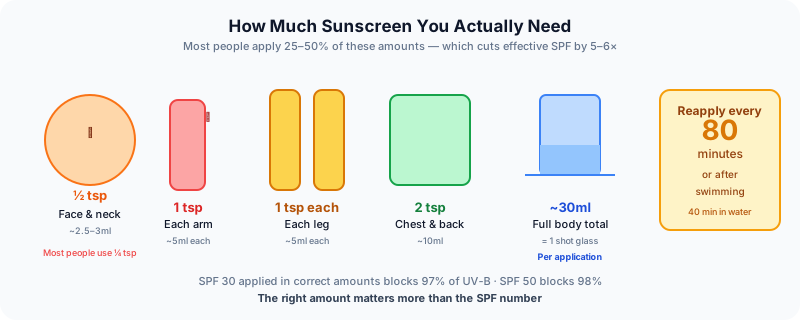
Full body (swimwear): 30ml — roughly a shot glass or a large palmful.
Face and neck: Half a teaspoon — about 2.5–3ml. This sounds like more than you think. Most people use a fingertip-sized amount. That's maybe 0.5–0.8ml. Significantly underapplied.
Arms: One full teaspoon each.
Legs: One full teaspoon each.
Back: Two full teaspoons.
If you're using a factor lower than needed because you're applying more — you're not actually compensating. UV protection doesn't scale linearly with application thickness. You need both: the right SPF and the right amount.
The easiest check: if you're finishing a 100ml sunscreen bottle from a full day of beach activity for yourself and one other person, your application is probably about right. If that bottle lasted 3 days, you were significantly underapplying.
When to Apply
20–30 minutes before going outside.
This applies to chemical sunscreens (which need time to absorb and activate) and is the standard recommendation for mineral sunscreens too — though mineral formulas work immediately on application.
The "apply before you leave the house" rule has a practical benefit beyond chemical activation: it catches the spots people miss. When you're in a hurry at the beach parking lot, you miss the backs of your hands, the back of your neck, your ears, the tops of your feet. When you apply at home before getting dressed, you get better coverage.
Common missed spots:
- Ears (especially the tops and behind)
- Back of neck (constantly sun-exposed while hiking or cycling)
- Tops of hands and feet
- Lips (yes — SPF lip balm exists for a reason)
- Hairline and scalp (especially if you part your hair)
- Back of knees
When to Reapply
Every 80–120 minutes of outdoor activity. Every 40 minutes when swimming.
The label says "water resistant (80 minutes)" which means the protection holds for up to 80 minutes in water before becoming unreliable — not that it's fully effective for 80 minutes regardless of conditions. On a very active, sweaty day, protection degrades faster.
The reapplication schedule most people should use:
- Low activity, not sweating: Reapply every 2 hours
- Active outdoor activity: Every 80 minutes
- Swimming, water sports: Every 40–60 minutes, or after toweling off (which physically removes sunscreen)
- High UV (index 9+) with sweating: Every 60 minutes to be safe
The mistake most people make: they apply sunscreen once in the morning and don't reapply. A full day at the beach is 8+ hours. An 80-minute application window means you need to reapply 5–6 times across the day. Most people reapply once or twice.
Carrying sunscreen in a pocket or beach bag matters. If it's in the cooler or the car, you won't reapply when you should.
Mineral vs. Chemical Sunscreen
This is the most debated topic in the sunscreen world. The honest answer: both work. The better answer: choose the one you'll actually use consistently.
Chemical Sunscreens
Active ingredients: Oxybenzone, avobenzone, octinoxate, octisalate, homosalate, and others.
How they work: Absorb UV radiation and convert it to heat, which dissipates from the skin.
Texture: Generally lighter, more invisible on skin, easier to spread. Often preferred for daily wear under makeup.
Wait time: Need 15–30 minutes to absorb before sun exposure.
Concerns: Some chemical filters (particularly oxybenzone) are under ongoing study for potential hormone disruption and coral reef effects. The FDA has requested more safety data on several active ingredients. Current evidence doesn't establish harm in humans at typical use levels, but if you're uncertain, mineral is a conservative choice — especially for young children.
Best for: Daily moisturizers with SPF, under-makeup formulas, light outdoor activity.
Mineral Sunscreens
Active ingredients: Zinc oxide, titanium dioxide.
How they work: Sit on the surface of the skin and physically reflect/scatter UV radiation.
Texture: Historically thick and white — the lifeguard nose look. Modern formulations are much better, but still tend toward thicker and, on some skin tones, visibly white.
Wait time: Work immediately on application.
Skin sensitivity: Better for sensitive skin, eczema-prone skin, and children under 6. Less likely to cause irritation or allergic reaction.
Best for: Children, sensitive skin, outdoor sports, anyone preferring well-studied ingredients.
The trade-off: Mineral sunscreens physically transfer to clothing, car interiors, and whatever you touch. On dark clothing, the white cast is visible and permanent. If you're doing a long hike, your pack straps will have zinc on them by the end of the day.
The Hybrid Approach
Many people use both: mineral sunscreen for the face (better for daily skin sensitivity and under makeup) and chemical sunscreen for the body (lighter, easier to spread over large areas). There's no reason not to mix them.
SPF in Moisturizers and Makeup
This is an important distinction.
SPF 30 moisturizer doesn't give you SPF 30 protection.
The SPF rating on cosmetics is calculated at the same 2mg/cm² application rate as dedicated sunscreen. But most people apply moisturizer in a far thinner layer — and most makeup, especially powder foundation, is applied even thinner.
Studies measuring actual UV protection from SPF-rated makeup found effective protection closer to SPF 3–5 in real-world application conditions.
SPF moisturizer and foundation are better than nothing. But they're not a substitute for dedicated sunscreen as your primary protection layer. The standard dermatological recommendation: dedicated SPF 30+ sunscreen applied first, then makeup or moisturizer on top.
Sunscreen and Vitamin D: The Concern People Have
A common worry: "If I wear sunscreen, won't I block vitamin D production?"
Theoretically yes — sunscreen blocks UV-B, which is what triggers vitamin D synthesis in skin.
In practice, this concern appears to be overstated. Epidemiological studies don't show vitamin D deficiency in regular sunscreen users. Likely reasons: people don't apply sunscreen perfectly (some UV still gets through), they have some unprotected skin exposure, and vitamin D is also available through diet and supplements.
If you're in a high-latitude location in winter where vitamin D synthesis is minimal regardless of sunscreen (UV-B is too weak above 37° north in November–March), supplementation makes more sense than trying to get it from sun exposure.
For most people: consistent sunscreen use does not meaningfully reduce vitamin D levels when compared to the alternatives (diet, supplementation, brief unprotected exposure to arms/legs in low UV conditions).
Sunscreen Specifically for Outdoor Activity
For Hikers and Trail Runners
Sweat resistance is critical. Look for water-resistant (80 minutes) formulas. Stick formats are easiest to apply on the move — a stick on your hands doesn't drip, isn't sensitive to wind, and fits in a vest pocket.
SPF 50 is worth it for extended mountain exposure — you're at altitude, where UV is 10–30% higher than at sea level, and you're out for hours. For sun safety on trails, see our complete hiking sun protection guide.
For Swimmers
Water-resistant doesn't mean waterproof. Reapply every 40 minutes, or after every time you towel off. Sport formulas with high water resistance hold up better in active water environments than standard formulas — check the label.
For Cyclists
Face, neck, and hands are the highest-exposure areas. Cyclists face the sun directly for hours at a time. Apply SPF 50 to face and the backs of hands specifically. A buff or neck gaiter provides reliable protection on the neck without reapplication issues.
For Urban Daily Wear
A simple SPF 30 moisturizer with broad-spectrum protection handles incidental daily UV exposure — walking to work, sitting near windows, outdoor lunch. You don't need SPF 50 for the walk to the coffee shop. For longer outdoor exposure, upgrade to dedicated sunscreen.
Building the Habit
The hardest part of sunscreen is habit formation.
The dermatologists who have the best outcomes with their patients don't recommend the "best" sunscreen. They recommend the one patients will actually use. A mediocre SPF 30 applied every day beats a premium SPF 50 that sits in the drawer.
A few approaches that work:
Anchor it to something you already do. Brush teeth → apply sunscreen. If your morning skincare routine already exists, add sunscreen to the end of it. The habit piggybacks on what's already automatic.
Eliminate the "it's cloudy" excuse. UV-B is present at meaningful levels whenever the UV index is 3 or higher. UV-A is present year-round. The sky color is not the indicator — UV index is. SunUp shows you the current UV index the moment you open it.
Solve for the texture you hate. The most common reason people skip sunscreen is that they find the texture unpleasant. There are enough formulas now that this is a solvable problem. Gel formulas, tinted mineral formulas, lightweight fluid formulas — if your current sunscreen feels like you're wearing a mask, try a different format before concluding sunscreen isn't for you.
Check UV before you make the decision. SunUp shows your real-time UV index and tells you your personalized safe time without sunscreen. Seeing that you have 15 minutes at UV 8 is more motivating than a generic "wear sunscreen" reminder.
FAQ
Is SPF 50 worth it over SPF 30?
For daily urban use: probably not worth the extra cost or thicker formula. SPF 30 blocks 97% of UV-B. SPF 50 blocks 98%. The difference is 1%. For extended outdoor activity — especially at altitude, on snow, or at the beach for a full day — the marginal extra protection is worth it. For a beach vacation at UV index 10, SPF 50 makes sense. For walking to work, SPF 30 is completely sufficient.
Can you layer sunscreen to get higher SPF?
No. Applying SPF 30 over SPF 30 gives you SPF 30, not SPF 60. SPF doesn't compound additively. The formula with the highest SPF in your layered system is effectively what you get — with the caveat that layering may affect application amount and consistency.
Does sunscreen expire?
Yes. Most sunscreens are formulated to remain effective for 3 years from manufacture, with a printed expiration date. After the expiration date, active ingredients may have degraded and protection is unreliable. If a sunscreen has been stored in heat (like a car or beach bag in summer), degrade faster. When in doubt, replace it.
How long does sunscreen last once applied?
On skin without water or significant sweat exposure: 80–120 minutes before a meaningful decrease in protection. In water or with heavy sweating: 40–60 minutes. "Water resistant (80 minutes)" on the label means it maintains protection for 80 minutes of water exposure — not that it lasts 80 minutes in all conditions.
Should I use spray sunscreen?
Sprays are convenient for reapplication, especially on children. The main problem: studies consistently show that spray application results in less even coverage and lower total application amounts. If you use spray, apply it and then rub it in — the rubbing ensures coverage and a more consistent film. Don't rely on a quick spray without rubbing for full protection.
Can sunscreen cause vitamin D deficiency?
Based on current research: unlikely in practice. While sunscreen theoretically blocks the UV-B needed for vitamin D synthesis, population studies don't show vitamin D deficiency in regular sunscreen users. Real-world application is imperfect (some UV reaches skin), and vitamin D can be obtained through diet and supplements. If you're concerned about vitamin D, supplements and diet are more reliable sources than UV exposure anyway.
Apply This Knowledge With SunUp
Get real-time UV data personalized for your skin type, location, and activity.
Download Free — iOS