
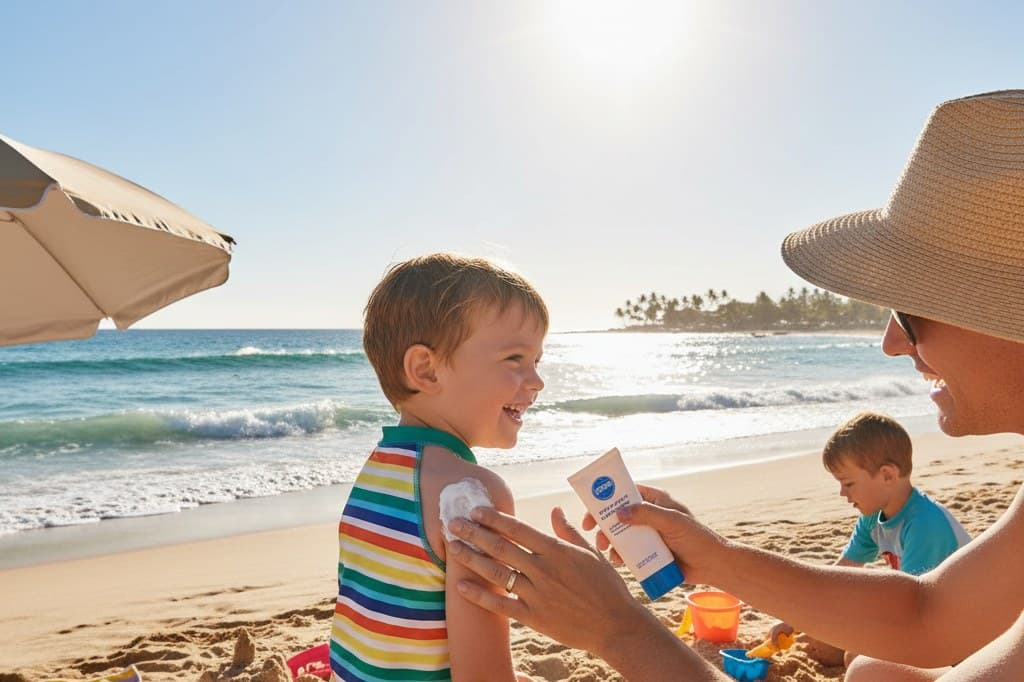

Water resistant sunscreen keeps its labeled SPF protection for 40 or 80 minutes in water — not forever, and not once you towel off. The number you see on the bottle ("Water Resistant (80 minutes)") comes from a specific FDA immersion test, not marketing. It means the formula held its SPF through four 20-minute water-soak cycles in a lab. It does not mean you are protected for 80 minutes of beach chaos.
Since 2011, the FDA has banned the words "waterproof," "sweatproof," and "sunblock" from sunscreen labels entirely. No sunscreen is waterproof. If you find an old bottle or an imported product that still says "waterproof," it is using language the FDA rejected as misleading.
This guide covers what water resistant actually means, when the 40- vs 80-minute distinction matters, the real-world things that destroy protection faster than the label suggests, and how to layer sunscreen with other protection so you are not relying on one product to do everything.
Quick Answer: "Water resistant (40 minutes)" means the sunscreen kept its SPF through two 20-minute water immersion cycles in FDA testing. "Water resistant (80 minutes)" means it survived four cycles. Neither rating survives towel drying — reapply immediately after you towel off, regardless of how much time has passed. Even with an 80-minute formula, the default rule still applies: reapply at least every 2 hours.
How the FDA Tests Water Resistance
The test is straightforward but tightly controlled — and that control is both its strength and its blind spot.
After sunscreen is applied, subjects wait 15 minutes for the film to set. Then they enter a water immersion tank for 20 minutes of moderate activity, followed by a rest period. For a 40-minute claim: two cycles. For an 80-minute claim: four cycles. SPF is measured after the full water exposure. If the formula held its labeled SPF, it earns the claim.
The catch: subjects do not towel off during the test. The SPF measurement is taken on wet, undisturbed skin. That is not how real life works. At a beach or pool, you towel off constantly — after every swim, after splashing, after kids climb out of the water and back in 30 seconds later. Each towel pass strips a layer of protection that the FDA test never measures.
The American Academy of Dermatology reinforces this: even with an 80-minute water resistant product, reapply immediately after towel drying, and at least every 2 hours regardless.
What water resistance testing does tell you is which formulas have film-forming ingredients — waxes, silicone resins, acrylate polymers — that anchor UV filters to skin during sustained water exposure. A formula without those ingredients loses SPF protection within minutes of getting wet. That is the real difference between water resistant and regular sunscreen: engineered film adhesion, not magic.
40 vs 80 Minutes: How to Choose
The choice is simpler than most sunscreen guides make it sound.
Get 80 minutes if: you are swimming for more than a few minutes, doing any water sport (paddleboarding, surfing, kayaking), running or cycling in summer heat where sweat is steady, or spending a full beach day in and out of the water. The 80-minute rating covers the most common real-world pattern: extended outdoor activity with intermittent water or sweat exposure.
40 minutes works for: short dips in a pool, light perspiration during a walk, an outdoor lunch where the main risk is ambient UV rather than water exposure. If you are not going to be in the water for more than a few splashes, the 40-minute rating is enough — but you still reapply every 2 hours.
None of this changes the baseline: SPF value does not affect durability. An SPF 100 water resistant sunscreen lasts exactly as long in water as an SPF 30 from the same formulation family. Higher SPF filters more UV-B (SPF 30 blocks 97%, SPF 50 blocks 98%, SPF 100 blocks 99%) but the film degrades at the same rate. Choosing SPF 50 over SPF 30 because you think it lasts longer in the pool is a mistake — one that costs real protection if it means you delay reapplication.
The Skin Cancer Foundation recommends broad-spectrum SPF 30 or higher and reapplication every two hours, or immediately after swimming or sweating — the same schedule regardless of SPF number.
What Actually Destroys Water Resistant Sunscreen
The FDA test removes one variable at a time. Real life throws all of them at you simultaneously.
Toweling off is the biggest protection-killer. Even a quick pat-down removes enough of the sunscreen film to compromise the SPF rating. The label says "water resistant (80 minutes)" — but if you towel off at minute 43, you are back to zero protection. This is the single most overlooked reapplication trigger.
Sand acts as a mechanical abrasive. Kids rolling in sand, wiping sandy hands on their arms, or rubbing their faces with gritty fingers — each action physically scrapes the sunscreen layer away. Beach days with kids are effectively a reapplication treadmill.
Friction from clothing — shirt collars rubbing the back of your neck, swimsuit straps shifting, arms brushing against kayak edges — wears down the film faster than submersion alone.
Sweat is treated the same as swimming by the FDA reapplication rules. Heavy sweating during a trail run or summer workout disrupts the sunscreen film just like water immersion does. If your sunscreen is water resistant (80 minutes), that protection window holds for sweat as well — but only if you are not wiping your face with a towel or shirt between intervals.
The practical rule: if sunscreen has been in contact with water, sweat, sand, or a towel, reapply. Do not try to calculate partial credit. The film is either intact or it is not.
Layer Sunscreen — Don't Bet Everything on One Product
The best water resistant sunscreen in the world still has failure modes: it misses spots, it wears off unevenly, and it needs reapplication at moments when you are busy or distracted. The solution is not a better sunscreen. It is layering.
UPF 50+ clothing — rash guards, sun shirts, swim leggings — does not wash off, does not need reapplication, and does not depend on application technique. For skin it covers, UPF clothing is the most reliable protection available. A long-sleeve UPF 50+ rash guard eliminates sunscreen compliance for the torso entirely — the single biggest win in family sun safety.
Wide-brim hats with a 3-inch (7.5 cm) brim protect face, ears, and the back of the neck simultaneously. These are the areas sunscreen misses most often: ears, hair parts, the neck just below the collar. GearTOP's Navigator UPF 50+ hat and Discoverer hat with removable neck flap both have full-circumference brims and UPF 50+ ratings — they block UV the way sunscreen cannot: mechanically, permanently, without reapplication.
Sunscreen fills the gaps. Face, hands, forearms, anything UPF clothing and hats leave exposed. Apply it 15–30 minutes before sun exposure so the film sets. Use enough — roughly a teaspoon for face and neck, a shot glass (30 ml) for full body. Reapply on schedule.
The UV index tells you how hard all of this matters. At UV index 3, a fair-skinned person may have 30–45 minutes before damage accumulates. At UV index 8, that drops to 10–15 minutes. The SunUp app gives you a real-time UV index for your location and calculates your personalized burn time based on your skin type and activity. It also sends reapplication reminders — the simplest way to close the gap between knowing you should reapply and actually doing it.
This layering system — UPF clothing + hat + sunscreen + UV awareness — means no single product carries the whole load. When the sunscreen wears off 20 minutes before you remember to reapply, the hat and rash guard are still working.
Frequently Asked Questions
What does water resistant sunscreen actually mean?
On a U.S. sunscreen label, "water resistant" means the product maintained its labeled SPF during standardized FDA water-immersion testing for either 40 or 80 minutes. The label must state which timeframe applies. It does not mean waterproof — that term has been banned on sunscreen labels since 2011.
Is waterproof sunscreen better than water resistant?
There is no such thing as waterproof sunscreen. The FDA banned the terms "waterproof," "sweatproof," and "sunblock" from sunscreen labels in 2011 because no sunscreen can survive water indefinitely. Every product on the shelf labeled water resistant has been tested to the same standard — the only difference is the duration: 40 or 80 minutes.
How often should I reapply water resistant sunscreen?
Reapply at least every 2 hours whether dry or wet. If swimming or sweating, reapply after the labeled time limit (40 or 80 minutes of water exposure). Immediately reapply after towel drying — even if you haven't hit the time limit, a towel strips the protective film.
Does SPF 50 water resistant sunscreen last longer than SPF 30?
No. SPF measures UV-B filtering (SPF 30 blocks 97%, SPF 50 blocks 98%) — not durability. A higher SPF does not extend how long the sunscreen stays effective in water. Both SPF 30 and SPF 50 water resistant formulas need reapplication on the same schedule: every 40 or 80 minutes when wet.
What destroys water resistant sunscreen faster?
Toweling off is the single biggest protection-killer — it physically wipes the sunscreen film away. Sand acts as a mechanical abrasive that scrapes the film off, especially with kids. Friction from clothing, swimsuit straps, and sports equipment wears down protection faster than water alone. Reapply after any of these.
Do I need water resistant sunscreen if I'm not swimming?
If you're sweating, yes. The FDA treats swimming and sweating the same for reapplication purposes — heavy perspiration disrupts the sunscreen film just like water does. For a sweaty hike, run, or yard work session in summer, water resistant (80-minute rated) sunscreen gives you more reliable coverage than standard formula.
What's the best water resistant sunscreen for kids?
For kids, choose broad-spectrum SPF 30+, mineral-based (zinc oxide or titanium dioxide), water resistant (80 minutes), and fragrance-free. Mineral formulas sit on top of skin rather than absorbing, which reduces irritation risk for sensitive children's skin. Reapply after every toweling — which with kids at a pool or beach is roughly every time they get out of the water.
Can sunscreen be water resistant and reef-safe at the same time?
Yes. Mineral water resistant sunscreens using zinc oxide or titanium dioxide are generally considered reef-safe because they do not contain oxybenzone or octinoxate — the two UV filters most associated with coral bleaching. Look for "reef-safe" on the label and verify the active ingredients are mineral-based. Water resistance and reef safety are achieved through different mechanisms and are compatible in the same formula.
The 30-Second Sunscreen Check
Before you buy or pack sunscreen for a water day, check three things on the label:
- Broad spectrum — protects against both UVA and UVB. Without it, you are blocking sunburn (UVB) but letting aging and deeper damage (UVA) through.
- SPF 30 or higher — SPF 30 blocks 97% of UVB. Above 50, the marginal gain is single percentage points and not worth paying double for.
- Water resistant (80 minutes) — the maximum rating available. If it says 40 minutes, you will be reapplying twice as often.
That is the whole checklist. Everything else — brand, price, texture, scent — is personal preference. If those three are on the label, you have a sunscreen that will do its job in the water. The rest is on you: apply enough, apply early, and reapply on time.
For days when you want to stop tracking reapplication manually, the SunUp app handles the timing — it knows your skin type, your location's real-time UV index, and reminds you to reapply when your protection window is closing. Pair it with a UPF 50+ sun hat from GearTOP and you have a protection system that works even when you are too busy having fun to think about sunscreen.
Apply This Knowledge With SunUp
Get real-time UV data personalized for your skin type, location, and activity.
Download Free — iOS