
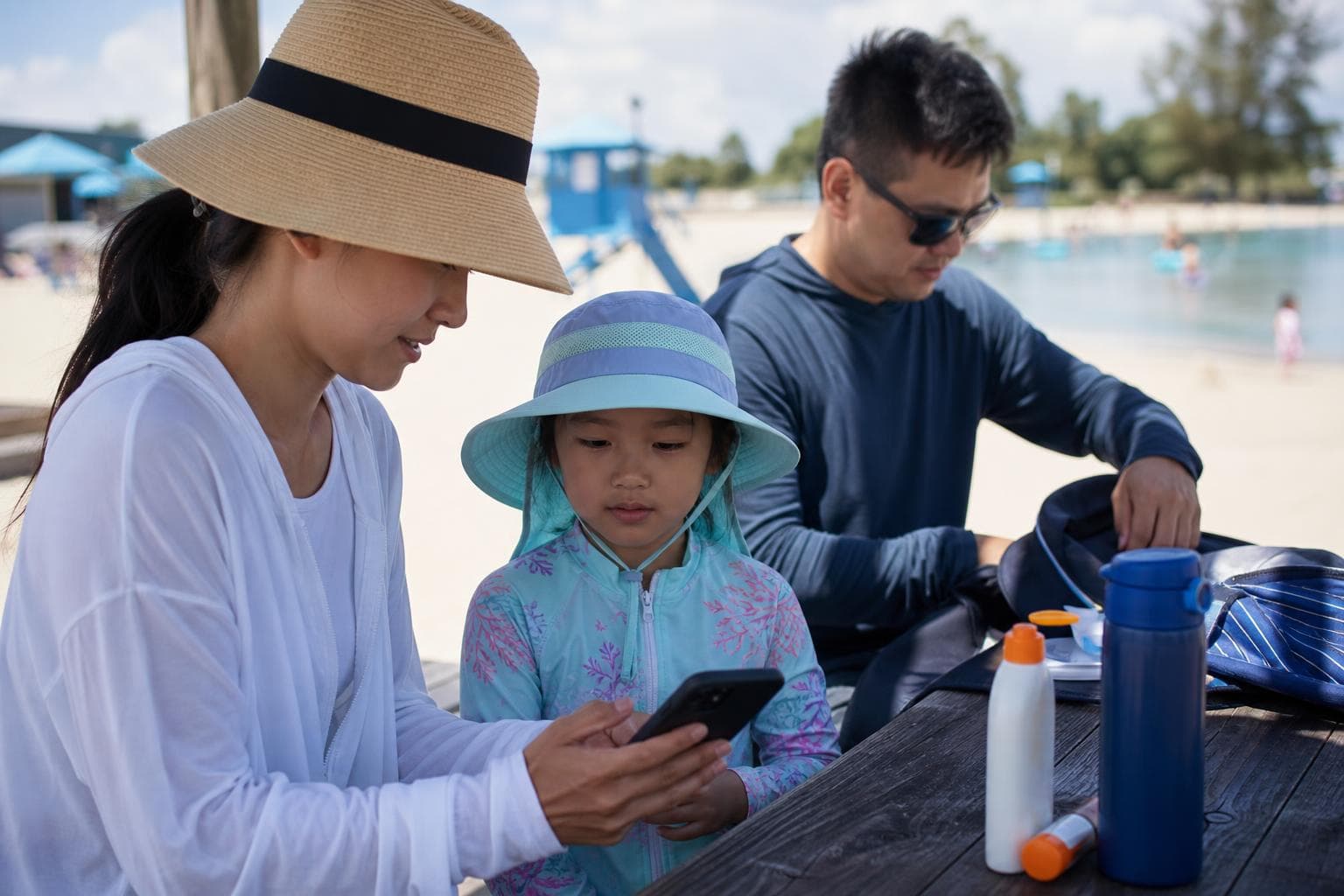

UV index 8 for kids means “very high” UV, and a fair-skinned child can start to redden in roughly 10 to 20 minutes without shade, sunscreen, or protective clothing. For families, the practical move is simple: treat UVI 8 as a planned-protection day, not a “we’ll see how it goes” day. The U.S. EPA UV Index Scale places 8, 9, and 10 in the “very high” category and recommends extra protection, especially from late morning through mid-afternoon. SunUp by GearTOP turns that public UV number into something parents can actually use: estimated burn time by skin type, location, forecast hour, and what each kid is wearing. That matters because your red-haired 7-year-old at the splash pad and your olive-skinned 11-year-old at soccer do not have the same clock. Kids burn fast. Plans help.
Quick answer: At UV index 8, plan for protection within 10–30 minutes for most kids, with fair skin near the low end and darker skin lasting longer but still needing eye, scalp, and heat-aware protection. SunUp estimates each family member’s burn time instead of showing one generic UV number.
What UV index 8 means in minutes for kids
UV index 8 means very high ultraviolet intensity, and many unprotected children can begin burning in about 10 to 30 minutes depending on skin type, altitude, cloud cover, reflection, and recent sun exposure. That is the parent answer. Not the meteorology answer. The World Health Organization describes the UV Index as an international measure of sunburn-producing UV radiation at the Earth’s surface, with higher values meaning greater risk in less time.
The minutes parents should remember
For summer 2026 planning, use this as a conservative starting point when the forecast says UV index 8: very fair skin may need protection before 10–15 minutes, fair skin around 15–20 minutes, medium skin around 20–30 minutes, olive to brown skin around 30–60 minutes, and deeply pigmented skin still needs protection for eyes, lips, scalp, and long outings. Those are planning ranges, not promises. A wet kid on white sand at noon can burn faster than the same kid under a tree at 4:30 p.m.
Most people get this wrong: UV index is not heat. A breezy 72°F beach day can have a UV index of 8, while a hazy 91°F late afternoon can have lower UV. The Skin Cancer Foundation makes the same point: UV intensity depends on factors like time of day, season, latitude, altitude, cloud cover, and ozone, not just temperature. Shade wins. Especially near water.
Why “UV index 8 for kids” should not be one number
UV index 8 for kids in SunUp by GearTOP is handled as a family timing problem, because one child might have skin type I and another might have skin type IV. A single weather app tile cannot know that. It also cannot know that your toddler is wearing a UPF 50 sun hat, your 10-year-old took off his rash guard after lunch, or your spouse forgot sunglasses. Honestly, most UV apps are fine at reporting the number and weak at answering the parent question: “How long do we have before we need to act?”
SunUp by GearTOP answers UV index 8 for kids with a personalized burn-time estimate, current UVI, 48-hour UV forecast, and family mode for up to 6 people. That is different from ranking the best UV index app for iPhone. This article is not that. This is about the summer planning math parents need before a four-hour pool day, a July zoo trip, or a beach morning that starts calm and turns intense by 11 a.m.
A plain-language burn-time table for UVI 8
| Skin type | Typical reaction | UVI 8 planning window | Parent move |
|---|---|---|---|
| Type I | Always burns, rarely tans | 10–15 minutes | Hat, SPF, shade before play starts |
| Type II | Burns easily, tans lightly | 15–20 minutes | Reapply timer and wide-brim hat |
| Type III | Sometimes burns, tans gradually | 20–30 minutes | Cover shoulders and check noon spike |
| Types IV–VI | Burns less often, tans more easily | 30–90 minutes | Protect eyes, scalp, lips, long exposure |
Summer 2026 family burn-time planning for UVI 8 days
A smart summer 2026 UV plan treats 10 a.m. to 4 p.m. as the decision window and uses the day’s highest UV hour to schedule sunscreen, UPF hats, shade breaks, and water activities. The plan does not need to be fussy. It needs to be early. And repeated.
The 4-hour outing plan
Here is a simple example for a July 2026 pool day from 10:30 a.m. to 2:30 p.m. with UV index 8 peaking near noon. At 10:15, apply broad-spectrum SPF 30 or higher, put UPF hats on every kid, and check SunUp family mode for each child’s burn-time estimate. At 11:15, move snacks into shade before the strongest hour. At 12:15, reapply sunscreen after swimming and towel drying. At 1:15, use a shade break, rash guards, or indoor lunch. At 2:00, check whether the UVI has started dropping before giving everyone “one more swim.”
The American Academy of Dermatology recommends broad-spectrum, water-resistant sunscreen with SPF 30 or higher, reapplied about every two hours and after swimming or sweating. That two-hour line is useful, but it is not the whole plan for kids. Sunscreen can be missed on ears, necks, hair parts, backs of hands, and under swimsuit straps. Hats cover the misses. Clothing covers the wiggles.
Check the forecast, not just right now
The standard advice to “check the UV index before you go outside” is actually backwards for families who leave early and stay out for hours. Check the next 4 to 6 hours, not just the current value. A 9:00 a.m. UV index of 4 can become UV index 8 by 11:30 a.m., right when the kids are finally settled at the beach and no one wants to stop for sunscreen. SunUp’s 48-hour UV forecast is built for that exact parent problem.
We see this pattern every summer with families who start at the playground in pleasant morning light and get surprised by the midday spike. The parents did check the weather. They checked temperature, rain, and maybe wind. But UV behaves on its own schedule, and UV index 8 for kids in SunUp by GearTOP is meant to turn that schedule into reminders before the red cheeks show up.
When UV is not the only clock
Mile 18 of a 22-miler with sharp medial knee pain mid-stride during taper, two weeks out from the Chicago Marathon, is not a UV-planning problem even if the UV index is 8; that runner needs to stop and get clinical guidance rather than trust a sun timer. Week 8 of a marathon block, on a 14-mile Sunday run with deep arch ache the morning after during a first fall marathon build, is also not solved by sunscreen, a hat, or an app. This does not work for injuries, heat illness symptoms, medication-related photosensitivity, or any child who seems dizzy, confused, chilled, or unusually tired. If you are dealing with those signs, skip the outdoor plan entirely and call a qualified professional.
Skin type differences: why two kids get different burn-time estimates
Skin type changes the burn-time estimate at UV index 8 because lighter skin has less natural UV-filtering pigment and usually reaches visible redness sooner than darker skin. That does not make darker skin “UV-proof.” It means the clock is different.
The parent-friendly Fitzpatrick scale
Dermatologists often describe sun response with the Fitzpatrick skin type scale, from type I to type VI. Type I skin is very fair, often with red or blond hair, freckles, and a pattern of burning quickly. Type II burns easily and tans lightly. Type III may burn but tans gradually. Type IV tans more easily and burns less often. Types V and VI have brown to deeply pigmented skin and generally burn more slowly, though sunburn can still happen, especially with long exposure, reflection, altitude, or medication sensitivity.
SunUp family mode asks for skin type because a family’s safest schedule is set by the shortest burn-time estimate, not the average. If one child has a UVI 8 estimate of 14 minutes and another has 35 minutes, the first child sets the sunscreen and shade rhythm. The same idea applies to grandparents, parents, babysitters, and cousins. One beach umbrella. Six different clocks.
Kids are not tiny adults outdoors
Children move differently. They kneel in wet sand, lean over splash tables, wipe their faces, sweat through sunscreen, and remove hats the moment a breeze kicks up. A skin type estimate is only useful if it is paired with real behavior. A child who sits under a canopy reading has a different risk than a child doing cannonballs for 90 minutes. Same UV. Different exposure.
The CDC sun safety guidance recommends shade, clothing, hats, sunglasses, and sunscreen as parts of sun protection. I like that order because it matches family reality: the best protection is the one that stays in place when a kid is distracted. A UPF hat does not need reapplying. A long-sleeve rash guard does not leave gaps on shoulders after towel drying.
Where skin type stops helping
Skin type does not account for every child. Some medications can increase sun sensitivity. Some medical conditions change the advice. Babies under 6 months need extra caution, with shade and protective clothing doing most of the work; parents should follow pediatric guidance for sunscreen on infants. Fresh sunburn changes the plan too. If a child burned yesterday, do not use today’s burn-time estimate as permission to go back into peak UV. Rest the skin. Choose shade. Not after lunch.
UV index 8 for kids in SunUp by GearTOP is a planning tool, not a medical diagnosis. It helps parents decide when to apply sunscreen, when to add a hat, when to move under shade, and when to set a reminder. It does not replace a pediatrician, dermatologist, or common sense when something looks wrong.
Sunscreen plus UPF hats beats sunscreen alone on UVI 8 days
Sunscreen and a UPF 50 hat protect kids better together at UV index 8 because sunscreen depends on perfect coverage while a well-made hat gives continuous shade to the scalp, face, ears, and neck. That is the boring truth. Boring works.
What UPF means in real terms
UPF stands for Ultraviolet Protection Factor, and it rates fabric rather than lotion. A UPF 50 fabric allows about 1/50 of UV through, which means roughly 2% transmission under test conditions. That is why UPF hats and sun shirts are so useful for kids: the protection is built into the fabric. The Skin Cancer Foundation explains that sun-protective clothing can be one of the most effective forms of UV protection because it creates a physical barrier.
GearTOP hats pair naturally with SunUp because the app tells you when the UV clock is short and the hat handles the areas parents miss most often. Ears. Hair parts. The back of the neck. For kids who hate lotion on their faces, a wide-brim UPF hat and sunglasses can reduce the daily battle, though exposed skin still needs sunscreen.
Sunscreen still matters
This is not an anti-sunscreen argument. For UVI 8, sunscreen is still part of the plan on exposed skin. The American Academy of Dermatology recommends SPF 30 or higher, broad-spectrum coverage, and water resistance for swimming or sweating. The problem is not sunscreen. The problem is treating sunscreen like a force field for a four-hour outing. It is not. It rubs off, washes off, gets under-applied, and gets forgotten when lunch runs late.
A practical family setup for UV index 8 is: SPF 30+ sunscreen on exposed skin, UPF hat for face and scalp, sunglasses for eyes, rash guard for water, and a shade break during the highest UV hour. SunUp notifications can remind you before the burn-time window closes, while GearTOP hats reduce how much of the plan depends on perfect lotion technique.
Reapply timing parents can actually follow
During a UVI 8 beach or pool day, set sunscreen timing around events rather than only the clock: before arrival, after swimming, after towel drying, after heavy sweating, and at least every two hours. A 10:00 a.m. application does not reliably carry a child through a 1:00 p.m. swim. But a reminder at 11:45, right before pizza or sandwiches, actually gets done.
UV index 8 for kids in SunUp by GearTOP works best when the app is the timing layer and GearTOP UPF gear is the always-on layer. One tells you when to act. The other keeps protecting while kids act like kids.
Shop GearTOP UV protection gear
How SunUp family mode turns UV index 8 into parent decisions
SunUp family mode turns UV index 8 into parent decisions by showing personalized burn-time estimates for up to 6 family members instead of one generic UV value. That is the difference between data and a plan.
Set up each family member once
In SunUp, a parent can add each person’s skin type and track how the current UV forecast affects that individual. For a family of four, that might mean a type II parent, a type I 6-year-old, a type III 9-year-old, and a type IV grandparent. When the UV index reaches 8, SunUp does not pretend they all have the same burn time. It shows the shortest window clearly enough that the parent can plan around it.
That matters most on mixed-activity days. A child at soccer camp has different exposure than a toddler in a stroller with a canopy. A parent gardening for 40 minutes has different exposure than a kid on a paddleboard. The app cannot make anyone wear a hat. But it can make the risk visible before the afternoon gets away from you.
Use alerts before the scramble
The best SunUp alert is the one that arrives before the family needs it. If the forecast shows UV index 8 from 11:00 a.m. to 2:00 p.m., set the plan before sunscreen-sticky hands, parking lots, towels, goggles, and snack negotiations take over. A high-UV notification gives you a nudge to put hats in the car, pack the shade tent, or shift the hike earlier.
SunUp also includes air quality index, which matters for families choosing between a long outdoor day and a shorter shaded outing. AQI does not change sunburn time the way UV does, but it can change whether a child with asthma or sensitive lungs should be doing hard outdoor activity. Sun safety and air quality belong in the same parent dashboard because real days do not arrive one variable at a time.
This is not a best-app roundup
A “best UV index app iPhone” post compares apps. This guide explains how to use one very high UV number with kids in summer 2026. The overlap is small on purpose. If you want a general app roundup, read our internal guide to the best UV index app for iPhone. If you want the parent workflow for a UVI 8 day, stay here: skin type, minutes, hats, sunscreen,
Best for
- Parents planning 15–90 minute summer outings with kids when UV index is 8, including beach mornings, playground stops, camp pickup, and 2–5 mile family walks.
- Families comparing burn-time differences by skin type, especially fair-skinned children who may redden quickly versus darker skin tones that still need UV protection.
- Caregivers building a practical sun plan using SPF 30–50 sunscreen, UPF 50+ hats, shade breaks, sunglasses, and SunUp family mode reminders.
- Summer 2026 travelers who need kid-specific UV guidance for high-UV destinations, pool days, theme parks, soccer tournaments, and midday road-trip stops.
- Readers who want a focused UV index 8 safety article with FAQ, schema, internal links, and a hero image rather than another general “best UV index app” roundup.
Not ideal for
- Children with active sunburn symptoms such as blistering, fever, chills, dizziness, nausea, or severe pain; these situations call for medical guidance, not burn-time planning.
- Infants under 6 months in direct sun, where shade, protective clothing, stroller canopies, and pediatric advice are more appropriate than relying on sunscreen timing.
- Families using photosensitizing medications or treatments, including some acne medications, antibiotics, antihistamines, or chemotherapy, without checking clinician-specific sun precautions.
- High-altitude or reflective-surface days such as skiing, boating, white-sand beaches, or 8–12 mile exposed hikes, where UV exposure can exceed standard backyard or playground assumptions.
- Situations requiring a medical diagnosis for rashes, heat illness, dehydration, unusual moles, or repeated burns; the article supports planning but does not replace professional care.
Frequently Asked Questions
What does UV index 8 mean for kids in minutes?
UV index 8 is classified as “very high,” meaning a child’s unprotected skin can start to redden in about 15 to 25 minutes, depending on skin type, altitude, cloud cover, and reflection from water or sand. The U.S. EPA recommends extra protection when the UV Index is 8 or higher: shade, protective clothing, sunglasses, and broad-spectrum sunscreen. Learn more in our UV index 8 kids guide.
How fast can a fair-skinned child burn at UV index 8?
A fair-skinned child, especially Fitzpatrick skin type I or II, may begin burning in roughly 10 to 20 minutes at UV index 8 without protection. Fitzpatrick skin typing is widely used to estimate sun sensitivity, with lighter skin types burning faster and tanning less. A PubMed-indexed review explains that skin phototype affects UV response and burn risk. For planning, start with the shortest likely burn time, not the average.
How should families plan outdoor time at UV index 8 in summer 2026?
For summer 2026, families should plan UV index 8 outings around short protected blocks: 20 to 30 minutes in direct sun, followed by shade, water, and sunscreen checks. The safest window is usually before 10 a.m. or after 4 p.m., because UV peaks near solar noon. Use a written plan for beach, camp, and sports days, and save a reusable checklist from our family sun planning guide.
Do darker skin tones still need protection when the UV index is 8?
Yes. Children with darker skin usually have more natural melanin protection, but UV index 8 can still cause sunburn, eye damage, heat stress, and long-term skin changes. The American Academy of Dermatology states that anyone can get skin cancer, regardless of skin color. Families should still use UPF clothing, hats, shade breaks, and SPF 30+ sunscreen on exposed skin, especially during midday play or water activities.
Is sunscreen enough for kids when the UV index reaches 8?
Sunscreen alone is not enough at UV index 8 because missed spots, sweat, swimming, and under-application reduce protection. Mayo Clinic recommends broad-spectrum SPF 30 or higher and reapplication at least every 2 hours, or sooner after swimming or sweating. Combine sunscreen with a UPF 50 hat, rash guard, sunglasses, and shade. This layered approach is more reliable for kids than relying on one product.
What UPF hat is best for kids on a UV index 8 day?
For a UV index 8 day, choose a kid’s hat labeled UPF 50 or UPF 50+, which blocks about 98% of UV radiation when the fabric is tested and worn correctly. A wide brim of at least 3 inches helps cover the ears, cheeks, and neck better than a baseball cap. For beach or camp, pair the hat with sunglasses and a chin strap; compare options in our UPF hats for kids guide.
How can SunUp family mode help with burn-time planning?
SunUp family mode helps parents plan around each child’s estimated burn time by combining the local UV index, skin type, sunscreen status, and outdoor schedule in one family view. On a UV index 8 day, a parent can set separate reminders for a fair-skinned toddler, a darker-skinned teen, and an adult coach. Use it for protection timing, not diagnosis; start with conservative limits such as 15-minute checks.
Can kids get sunburned at UV index 8 on cloudy days?
Yes. Clouds can reduce visible brightness while still allowing substantial UV radiation through, so kids can burn at UV index 8 even when the sky looks hazy or partly cloudy. The World Health Organization notes that UV levels are affected by cloud cover, altitude, ozone, latitude, and reflection from surfaces such as water, sand, and snow. Treat any forecasted UV index 8 as a high-protection day, not a “maybe sunscreen” day.
Apply This Knowledge With SunUp
Get real-time UV data personalized for your skin type, location, and activity.
Download Free — iOS