
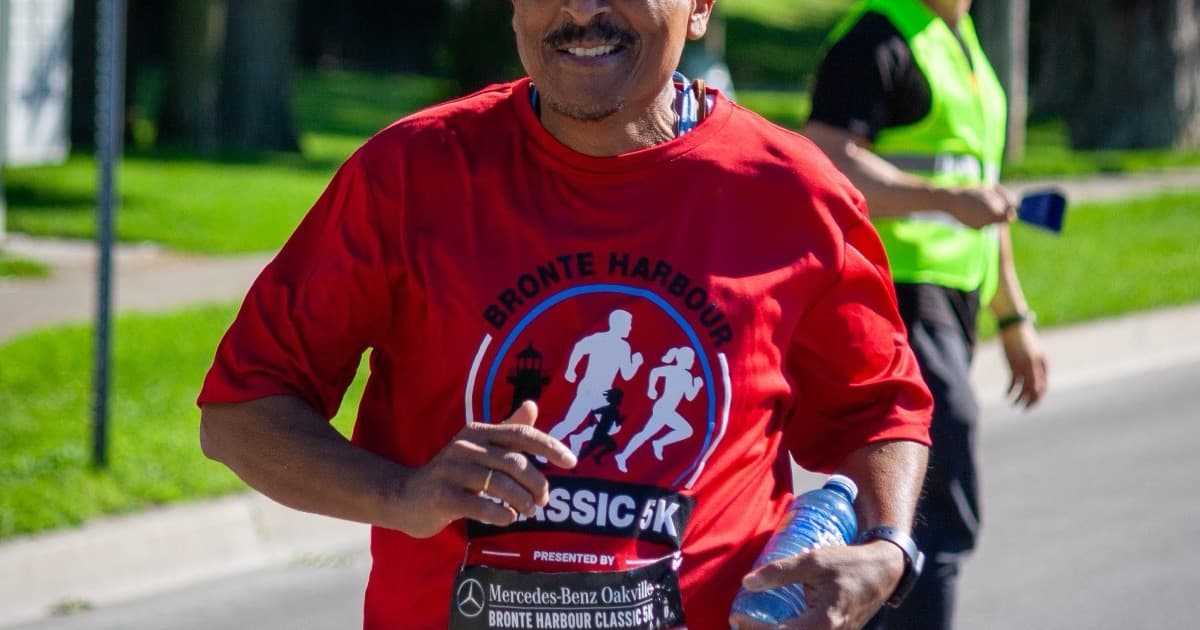

More than 900 runners lined up for the first Bronte Harbour Classic on Father's Day morning, and the forecast was the one every summer racer should plan for: clear, warm, full sun, no cloud cover. That combination is exactly when people get caught out — because warmth and UV are not the same thing, and an 8:30 AM start feels gentle even when the ultraviolet is already past the level where dermatologists recommend protection.
This is a science-forward guide to sun protection for runners, using that morning in Oakville as the worked example. The principles apply to any clear-sky run, race or training, anywhere the sun is up.
Quick Answer: Protect your skin for the whole time you're outside, not just the run. Apply broad-spectrum SPF 30+ before you arrive, wear a UPF 50+ wide-brim hat that shades your face, ears, and neck, add UV-blocking sunglasses, and check the live UV index and your personal burn time before the start so you know how much exposure you're actually managing.
A Race Is Longer Than the Race
Your sun exposure on race day lasts far longer than the run itself. The 5K takes most runners 20 to 40 minutes. But you arrive early to collect your bib, warm up, and find your corral. You run. Then you stay for results, photos, and the post-race festival. At the Bronte Harbour Classic, the kids' 1K went off at 8:00 AM, the 5K at 8:30, and the festival ran into the afternoon. Add it up and a "morning 5K" easily means two to three hours in open sun beside Lake Ontario.
The location made the dose stronger, not weaker. Bronte Heritage Waterfront Park sits right on the lake, and water reflects ultraviolet back up at you on top of the direct sunlight overhead. The clear sky that produced great race photos also meant nothing was filtering the sun. The lesson generalizes: treat the entire morning as sun exposure, and treat an open, reflective venue as a higher dose than the shade nearby would suggest.
Heat Is Not UV — Why Early Morning Fools People
The UV index tracks the sun's angle and the state of the atmosphere, not the temperature. That single fact explains most race-day sunburns. On a clear June day in southern Ontario, the index climbs through the morning, peaks around solar noon, and crosses the "protection recommended" threshold of UV 3 well before a 9 AM coffee. The morning air feels cool and forgiving. Your skin is on a different clock entirely.
The Skin Cancer Foundation and the U.S. EPA both use UV 3 as the line where sun protection becomes worthwhile. Conventional advice says avoid the peak hours of 10 AM to 4 PM — and that holds — but it quietly misleads runners into thinking a pre-10 AM start is automatically safe. On a clear summer day it often isn't. The index is simply lower at 8:30 than at noon; lower is not the same as low.
This is the gap the SunUp by GearTOP app is built to close. Instead of guessing from how warm it feels, you see the live UV index, a 48-hour forecast, and your personal burn time based on your skin type. For a race, that turns an abstract worry into a clear instruction. On June 21, the answer was simply "cover up." On a different morning it might give you a real, safe window before the index climbs.
Burn Time Depends on Your Skin: The Fitzpatrick Scale
How fast you burn is not the same for everyone, and the difference is large. Dermatologists use the Fitzpatrick scale, which sorts skin into six types by how it responds to sun. Very fair skin that always burns and never tans is Type I; deeply pigmented skin that rarely burns is Type VI. At the same UV index, the burn window between those extremes spans from roughly half an hour to several hours.
| Fitzpatrick type | Typical description | Approx. burn time at UV 5 |
|---|---|---|
| Type I | Very fair, always burns, never tans | ~30 minutes |
| Type II | Fair, burns easily, tans minimally | ~40 minutes |
| Type III | Medium, sometimes burns, tans gradually | ~60 minutes |
| Type IV | Olive, rarely burns, tans easily | ~90+ minutes |
| Type V–VI | Brown to dark brown, very rarely burns | 2–3+ hours |
These are estimates, not guarantees, and burn time roughly halves as the UV index climbs — so a window that lasts an hour at UV 5 shrinks toward 30 minutes at UV 8. The practical point for runners: a Type I or II runner can exceed their unprotected burn window during warm-up alone on a clear race morning, long before the finish line. Knowing your type turns "be careful" into a number you can actually plan around, which is exactly what a personal burn time gives you.
The Surfaces Under You Add to the Dose
Most sun-safety advice only counts the sun overhead, but reflected UV is real and runners meet a lot of it. Reflective surfaces bounce ultraviolet back up at your face and the underside of your chin — areas a cap or even a brim doesn't fully cover. The numbers, drawn from dermatology guidance:
- Water: reflects roughly 10% of UV — relevant for any waterfront, lakeside, or coastal course.
- Dry sand: 15–20% — beach runs and dune trails.
- Fresh snow: up to 80% — winter and alpine running, often badly underestimated.
- Concrete and light pavement: a smaller but genuine bump, and most road races run on exactly this.
A lakeside course on light asphalt, like Bronte's, stacks two reflective sources under a clear sky. That's why the total dose can outrun what the shade and the early hour seem to promise.
Cloud Doesn't Save You Either
A grey sky is one of the most convincing reasons runners skip protection, and one of the least reliable. Up to about 80% of UV radiation passes through light cloud cover. UVA — the wavelength most associated with long-term skin aging and damage — penetrates cloud almost unchanged. Cloud lowers the temperature far more than it lowers the UV, which is precisely why a cool, overcast day feels safe when your skin is still taking a meaningful dose. The fix is the same on every day: read the UV index, not the sky.
What Actually Works on Race Day
Here are three layers, ordered by how reliable they are — most dependable first.
- A UPF 50+ hat. The most dependable layer, because it never sweats off and never needs reapplying. UPF 50+ fabric blocks roughly 98% of UV. A wide-brim or boonie style shades the three areas that burn first and worst: the face, the ears, and the back of the neck. A baseball cap shades only your face and leaves ears and neck exposed. This is why hats matter for runners; the GearTOP Discoverer adds a drop-down neck flap and vents the heat so you're not trading sunburn for overheating.
- Broad-spectrum sunscreen, SPF 30+ (SPF 50 for longer efforts). Apply 15 to 30 minutes before you arrive, on everything the hat can't cover: shoulders, arms, and the back of the neck if you skip the flap. Use a sport or water-resistant formula, and accept that it degrades with sweat during a hard run. Reapplication every two hours is the standard, but almost nobody reapplies mid-race — which is the whole reason sunscreen is layer two, not layer one.
- UV-blocking sunglasses and light, covering clothing. Wraparound UV400 sunglasses protect your eyes and the thin skin around them, and a hat plus good sunglasses together can cut UV to the eye area by up to 98%. A technical singlet, a long-sleeve UV shirt for fair-skinned runners, and shade between efforts are the small things that add up over a long morning outside.
The Takeaway
A clear, warm race morning is a great day to run and an easy day to burn. The runners who finished the Bronte Harbour Classic comfortable and protected didn't do anything complicated. They covered up, understood that the UV was real despite the early hour, and treated the whole morning as sun exposure rather than just the 5K. Check the index, know your burn time, wear the hat, and enjoy the finish line.
Read the full event story in the Bronte Harbour Classic 2026 recap.
FAQ
What UV index is high enough to worry about for a run?
A UV index of 3 or higher is the point where skin protection is recommended, per the Skin Cancer Foundation and the EPA. On a clear summer morning the index often crosses 3 well before mid-morning. Check the live UV index and your personal burn time before you head out instead of judging by how warm it feels — heat and UV are not the same signal.
Can you get sunburned during an early-morning race?
Yes. By 8:30 AM in June at Canadian latitudes the UV index is already above the protection threshold, and a race means you're outside for two to three hours across warm-up, the run, and the festival afterward. On a clear morning that cumulative dose is more than enough to burn unprotected skin — especially the face, ears, neck, and shoulders, which catch the most direct sun.
Is sunscreen or a hat better for running in the sun?
Use both. Sunscreen covers skin a hat can't reach, but it sweats off during a hard run and almost nobody reapplies mid-race. A UPF 50+ hat keeps shading your face, ears, and neck the whole time and never needs reapplying. The combination — broad-spectrum sunscreen plus a wide-brim hat — is far more reliable than either one on its own.
How long does it take to burn while running?
It depends on your skin type and the UV index. Using the Fitzpatrick scale, very fair skin (Type I) can burn in roughly 30 minutes at UV 5, while darker skin (Type IV) takes a few hours. A typical race morning easily exceeds the burn window for fair-skinned runners once you count warm-up, the run, and standing around afterward.
Do you still need sun protection on a cloudy or cool day?
Yes. Up to about 80% of UV radiation passes through light cloud, so an overcast sky filters very little of the rays that cause burning and skin damage. Cloud cover also lowers the temperature, which makes a cool, grey day feel safe when it isn't. UVA in particular penetrates cloud almost unchanged, so check the UV index rather than the sky.
Does running near water or pavement increase sun exposure?
Yes. Reflective surfaces bounce UV back up at you on top of the direct sunlight overhead. Water reflects roughly 10% of UV, dry sand 15 to 20%, and fresh snow up to 80%. Light concrete and pavement add a smaller but real amount. A waterfront or open paved course raises your total dose above what the available shade suggests.
What is the best time of day to run to avoid the sun?
UV is lowest before about 10 AM and after 4 PM, with the peak around solar noon. Early morning is genuinely the safest window, but on clear summer days the index still climbs past the protection threshold of 3 before mid-morning. Early helps, but it is not a substitute for a hat and sunscreen once the UV index is 3 or higher.
Apply This Knowledge With SunUp
Get real-time UV data personalized for your skin type, location, and activity.
Download Free — iOS