

The Five Rules That Actually Matter
You have probably heard "wear sunscreen" a thousand times. But wearing it and wearing it correctly are different things—and the gap between them is where sunburns happen.
Most people use 25-50% of the recommended amount. A landmark 2002 study in the Archives of Dermatology found that when people apply half as much sunscreen as directed, SPF 30 drops to roughly SPF 5. Half-application, one-tenth the protection.
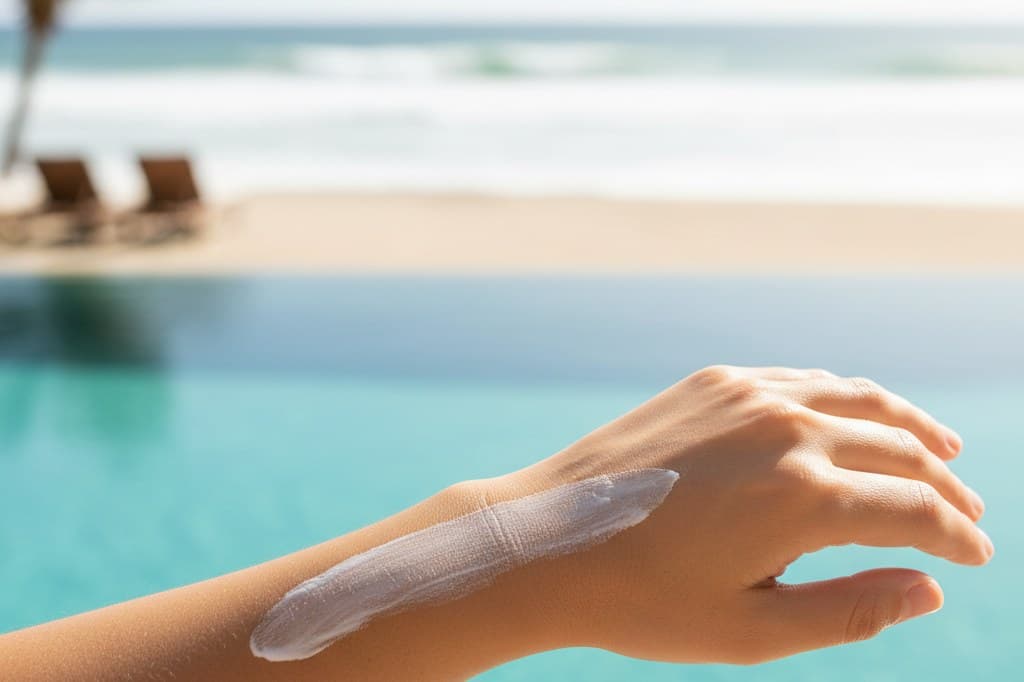
Quick Answer: Apply 1 ounce (a shot glass) to your body and ½ teaspoon (two finger-lengths) to your face and neck, 15 minutes before going outside. Use broad-spectrum SPF 30+, reapply every 2 hours or after swimming or sweating, and do not forget your ears, neck, tops of feet, and lips. That is the short version. Below is everything else you need to know.
These are not complicated rules. The challenge is that sunscreen is invisible once applied—you cannot see where you missed or when it wears off. That is where most people get burned, literally.
The good news: once you build the habit of applying it right, it takes about 60 seconds. And the difference between "some sunscreen" and "enough sunscreen" is the difference between a red, painful Tuesday and a Tuesday where you forget you were even outside.
How Much Sunscreen to Actually Use
The numbers are simple. Following them is where people slip.
Full body (bathing suit coverage): 1 ounce. That is a shot glass worth of sunscreen—about 30 mL or 6 teaspoons. If your bottle is 5 ounces (150 mL), you should get roughly 5 full-body applications from it. If a bottle lasts you all summer, you are not using enough.
Face and neck: ½ teaspoon. The American Academy of Dermatology (AAD) recommends the "two-finger method": squeeze sunscreen along the length of your index and middle fingers, from base to tip. That is your face and neck dose.
Each arm: ½ teaspoon. Each leg: 1 teaspoon. Front torso and back torso: 1 teaspoon each.
These add up quickly, which is intentional. If you are in a swimsuit at the beach, that 1-ounce total should feel like a lot of product. If it feels like you are barely using any, you are under-applying.
What Actually Happens When You Use Less
| Amount Applied | Effective SPF (from SPF 30) | Protection Level |
|---|---|---|
| Full recommended amount (2 mg/cm²) | SPF 30 | ~97% UVB blocked |
| Half amount (1 mg/cm²) | SPF ~5-8 | Minimal protection |
| Quarter amount (0.5 mg/cm²) | SPF ~2-3 | Almost none |
This is not linear. Cutting the amount in half does not give you SPF 15—it drops you to SPF 5 or lower. The relationship between thickness of sunscreen film and protection is exponential, which is why dermatologists are so particular about the amount.
The full-application number comes from the FDA's sunscreen testing standard: 2 milligrams of sunscreen per square centimeter of skin. That is the thickness at which the labeled SPF was actually measured. Anything less, and you are operating below the tested protection level.
When and How Often to Reapply
Sunscreen is not a "one and done" product. It breaks down. You sweat. You touch your face. You jump in the water.
Every 2 hours. Set a timer. Even if you are just sitting at a picnic table, sunscreen's protective film degrades over time as the active ingredients absorb UV and break down. After 2 hours, the protection is substantially reduced.
Immediately after swimming or sweating. Water-resistant means the sunscreen stays effective in water for either 40 or 80 minutes, depending on the label. It does not mean waterproof—the FDA banned that word from sunscreen labels in 2011 because no sunscreen is truly waterproof. After your 40 or 80 minutes are up, reapply as soon as you dry off.
Reapply after toweling off. Toweling physically removes sunscreen, even water-resistant formulas. If you towel dry after a swim, reapply immediately.
One exception: indoors all day. If you work inside and are not near a window with direct sunlight, a single morning application is adequate. But if you go outside for lunch, reapply before stepping out.
This is where apps become genuinely useful. SunUp sends reapplication reminders based on your location's UV index and your activity—so you do not have to remember to check a timer. It also tells you your personal burn time, which changes with UV index throughout the day. On a UV 10 day, your window might be 15-20 minutes. On a UV 4 day, it might be over an hour. Both still require reapplication every 2 hours, but the urgency shifts.
The Spots Everyone Misses
Dermatologists have a consistent list of body parts that patients routinely skip. These are also the spots where skin cancers frequently appear.
Ears. Tops, backs, and the ridges. Basal cell carcinomas on the ear are common, especially in men with short hair. Use a stick sunscreen here—it is easier to control and stays put.
Back of the neck. The collar zone gets sun exposure from above and reflected light from below. This is one of the most frequently burned areas.
Tops of feet. Flip-flops leave feet fully exposed. Missed sunscreen here means a painful burn that makes wearing shoes miserable for days.
Scalp and hair part. If you have thinning hair or a visible part, that strip of scalp gets direct overhead UV all day. Use a spray sunscreen on the part line or, better yet, wear a wide-brim sun hat. A UPF 50+ hat from GearTOP's sun protection collection protects your scalp, ears, and neck in one move—no reapplication needed.
Eyelids and around the eyes. The skin here is the thinnest on your body. Stick sunscreens are ideal because they do not run into your eyes when you sweat.
Lips. The lower lip catches reflected UV from water, sand, and pavement. Lip balm with SPF 30+ is not optional—it is one of the most common sites for squamous cell carcinoma.
Backs of hands. Hands get washed constantly, and sunscreen washes off with soap. Reapply after hand washing if you are outdoors.
Backs of knees. Easy to miss when you are applying sunscreen standing up. Bend your knees and apply to the creased skin.
If you have a partner or friend nearby, ask them to get your back—and check that you have not missed a strip down the middle of your shoulders where your hand cannot quite reach. A spray sunscreen with a continuous nozzle helps for self-application on the back.
Applying Sunscreen to Your Face: Moisturizer, Makeup, and the Right Order
The face is where people get the most particular about sunscreen—and where application order matters most.
The correct order: cleanser → moisturizer → sunscreen → makeup.
Apply moisturizer first and let it absorb for about a minute. Then apply sunscreen. Wait at least 5 minutes for the sunscreen film to set before putting on makeup. Rushing this step is why foundation often pills or slides.
How much for your face: ½ teaspoon, or the two-finger method. If that sounds like a lot, it is—and that is the point. Most face sunscreens are designed to absorb quickly, so the right amount should blend in within 30 seconds of rubbing.
Reapplying over makeup. This is genuinely tricky. Options that work:
- Powder SPF: Brush-on mineral powder sunscreen goes on over makeup without disturbing it. Look for SPF 30+.
- Setting spray with SPF: Mist over finished makeup. Less precise than cream but better than skipping reapplication.
- Dab with a sponge: Squeeze a small pool of liquid sunscreen onto a makeup sponge and dab—do not rub—over your makeup.
Mineral vs. chemical on the face: Mineral sunscreens (zinc oxide, titanium dioxide) sit on top of the skin and reflect UV. They are less likely to irritate eyes or sensitive skin but can leave a white cast. Chemical sunscreens absorb into the skin and convert UV to heat. They disappear completely but can sting eyes. If you have sensitive skin or are prone to melasma, tinted mineral sunscreens with iron oxide offer additional protection against visible light, which can trigger dark spots.
Choosing the Right Sunscreen
Walk into any drugstore sunscreen aisle and you face dozens of options. Here is what actually matters.
The Non-Negotiables
- SPF 30 or higher. SPF 15 blocks ~93% of UVB. SPF 30 blocks ~97%. SPF 50 blocks ~98%. The gains are incremental above 30, but the extra margin helps compensate for under-application.
- Broad spectrum. Must say this on the label. It means the sunscreen protects against both UVA (aging, penetrates deep) and UVB (burning).
- Water resistant. Even if you do not plan to swim, you sweat. The label specifies 40 or 80 minutes of water resistance.
Formulation Guide
| Form | Best For | Watch Out For |
|---|---|---|
| Cream / Lotion | Dry skin, face, careful application | Heavier feel; takes longer to rub in |
| Gel | Oily skin, hairy areas (chest, legs) | Can pill under makeup |
| Stick | Around eyes, ears, lips, precise spots | Hard to gauge amount; go over each area twice |
| Spray | Quick application, reaching your back, kids who won't sit still | Easy to miss spots; spray until skin glistens, then rub in; avoid inhaling—do not spray directly on face |
"Best sunscreen" is the one you will actually use. A dermatologist-recommended SPF 50 that sits unused in your cabinet protects you less than an SPF 30 you apply daily without thinking about it.
How SunUp Makes This Easier
The rules above are not hard to understand—but they are easy to forget in the moment. SunUp solves the two biggest sunscreen compliance problems:
Reapplication timing. SunUp sends a push notification when your 2-hour window is up, adjusted for your activity. Swimming? It reminds you sooner. Working indoors with a lunch walk planned? It alerts you before you step outside.
Personalized UV risk. The UV index in your location determines how urgently you need protection. On a UV 3 day, a 30-minute walk without sunscreen might cause minimal damage. On a UV 11 day, that same walk could burn unprotected skin in under 10 minutes. SunUp calculates your personal burn time based on your skin type, the current UV index, and your activity—so you know exactly when to reapply, not just that you should.
SunUp is free on iOS. Download SunUp and let the app track your reapplication windows so you do not have to.
Sunscreen Alone Is Not Enough
Sunscreen is one tool. Physical protection is the other—and it works without reapplication, without degradation, and without user error.
Hats. A wide-brim hat (3+ inches) shades your face, ears, and neck continuously. GearTOP's Navigator and Discoverer sun hats are UPF 50+ rated—meaning the fabric blocks 98% of UV radiation. Unlike sunscreen, a hat does not need to be reapplied every 2 hours. For hiking, fishing, gardening, or any extended outdoor activity, a UPF hat is the single highest-leverage sun protection move you can make.
Sunglasses. UV exposure contributes to cataracts, macular degeneration, and photokeratitis (sunburned eyes). Look for lenses labeled "100% UV protection" or "UV400." Darkness of the lens has nothing to do with UV protection—cheap dark sunglasses without UV coating are worse than wearing nothing because they cause your pupils to dilate, letting in more unfiltered UV.
UPF clothing. A standard white cotton t-shirt has a UPF of about 5-7—meaning 1/5th to 1/7th of UV gets through. A UPF 50+ shirt blocks 98%. For children who hate sunscreen application, a UPF rash guard or sun shirt solves the problem entirely.
Shade. UV is highest between 10 a.m. and 4 p.m. If your shadow is shorter than you are tall, seek shade. But remember: shade only blocks direct UV—reflected UV from sand (up to 15%), water (up to 10%), concrete, and snow still reaches you. Sunscreen plus shade is the real play.
Frequently Asked Questions
Does sunscreen prevent tanning?
No sunscreen blocks 100% of UV, so some tanning can still occur. But "tanning safely" is a myth—any change in skin color from UV exposure signals DNA damage. The goal of sunscreen is to minimize cumulative UV damage, not to prevent every photon from reaching your skin.
Can I mix sunscreen with moisturizer?
No. Mixing dilutes the sunscreen unevenly, creating patches of low protection. Apply moisturizer first, let it absorb, then apply sunscreen on top as a separate layer.
Do I need sunscreen if my makeup has SPF?
Yes. Makeup with SPF is rarely applied thickly or evenly enough to provide the labeled protection. Treat SPF makeup as a bonus layer, not your primary sunscreen. Apply a dedicated sunscreen underneath.
How do I know if my sunscreen is expired?
Check the expiration date on the bottle. If there is no date, the FDA considers it expired 3 years after purchase. Signs of degradation: separation (watery liquid on top), graininess, change in color or smell, or difficulty squeezing out of the tube. When in doubt, replace it.
Is spray sunscreen as effective as lotion?
It can be—if you apply enough. The problem with sprays is that it is hard to see how much is landing on your skin. Rule of thumb: spray until the skin glistens visibly, then rub it in. Never spray directly on your face (inhaling sunscreen is harmful); spray into your hands first, then apply. And do not use spray sunscreen on windy days—half of it blows away before reaching your skin.
Should I use a different sunscreen for my face and body?
You do not have to, but face-specific sunscreens tend to be lighter, non-comedogenic (won't clog pores), and formulated to sit well under makeup. If your body sunscreen does not break out your face and you like how it feels, it works. If you find it too heavy or greasy, a separate face sunscreen is worth it.
Download SunUp for free on iOS and get personalized UV index, burn-time estimates, and reapplication reminders for your location. Get SunUp on the App Store →
For all-day outdoor activities, pair SunUp's real-time UV tracking with GearTOP UPF 50+ sun hats—the combination of smart sunscreen habits and physical protection is the most reliable way to avoid sun damage.
Apply This Knowledge With SunUp
Get real-time UV data personalized for your skin type, location, and activity.
Download Free — iOS